Other / Mixed , formulas + CAT PYQs
Focused Number System kit. The full chapter formula sheet (with explanations & basic examples) is tucked below; every CAT PYQ for Other / Mixed is here.
Number System, formula sheet
Show the full Number System formula sheet (explanations + basic examples)
- By 2: last digit is 0, 2, 4, 6 or 8.
- By 4: last two digits divisible by 4 (or both zero).
- By 8: last three digits divisible by 8 (or all zero).
- General rule: divisible by 2ⁿ if the last n digits are divisible by 2ⁿ.
- Use it to test divisibility by a power of 2 without dividing the whole number.
- e.g. 1316 → last two digits 16, and 16 ÷ 4 = 4, so 1316 is divisible by 4.
- By 3: digit-sum is divisible by 3.
- By 9: digit-sum is divisible by 9.
- Just add the digits, if that small sum passes, the whole number does.
- e.g. 4527 → 4+5+2+7 = 18, divisible by both 3 and 9, so 4527 is too.
- By 5: last digit is 0 or 5.
- By 6: divisible by its co-prime factors 2 and 3 (6 = 2 × 3).
- By 12: divisible by both 3 and 4.
- For any composite, test divisibility by its co-prime factors.
- Break a composite divisor into co-prime parts and check each separately.
- e.g. 132 is divisible by 12 because it is divisible by 3 (1+3+2=6) and by 4 (last two digits 32).
- Make groups of three digits from the right.
- Take (sum of odd-placed groups) − (sum of even-placed groups).
- If that difference is divisible by 7 / 11 / 13, so is N.
- Same grouping rule works for all three primes.
- Lets you test big numbers for 7, 11 or 13 using small 3-digit chunks.
- e.g. 1001 = 7×11×13, so any 3-digit block repeated (e.g. 256256) is divisible by all three.
- Take (sum of odd-placed digits) − (sum of even-placed digits).
- If the difference is divisible by 11, the number is too.
- Quick single-digit alternating add/subtract test for 11.
- e.g. 918082 → (9+8+8) − (1+0+2) = 25 − 3 = 22, divisible by 11, so 918082 is too.
- For 13: one-more osculator 4, drop last digit, add 4 × (last digit), repeat.
- For 17: negative osculator 5, drop last digit, subtract 5 × (last digit), repeat.
- A shrink-and-repeat trick to test 13 or 17 when no other rule is handy.
- e.g. 13 itself: 1 + 3×4 = 13 → divisible by 13.
- Natural N = {1, 2, 3…}; Whole W = N ∪ {0}.
- Integers Z = {… −2, −1, 0, 1, 2 …}.
- Rational = p/q, q ≠ 0 (terminating or recurring decimals).
- Irrational = non-terminating, non-recurring (√2, √3, π).
- Complex a + ib; conjugate of a + ib is a − ib.
- Knowing which set a number lives in tells you what operations stay "closed".
- e.g. 0.75 = 3/4 is rational; √2 = 1.41421… never repeats, so it is irrational.
- A prime has exactly two factors: 1 and itself.
- Primes > 3 are of the form 6k ± 1 (converse not always true).
- 1 is neither prime nor composite; 2 is the only even prime.
- The 6k±1 form lets you scan candidates for primes quickly.
- e.g. 7 = 6×1+1 and 11 = 6×2−1 are prime; but 25 = 6×4+1 is not (converse fails).
- Pick the smallest n with n² > N.
- Check divisibility by every prime < n.
- If none divides N, then N is prime.
- You only need to test primes up to √N, not all the way to N.
- e.g. 97: √97 ≈ 9.8, test 2,3,5,7, none divides 97, so it is prime.
- Two numbers with no common factor except 1.
- 1 is co-prime to every number; two consecutive integers are co-prime.
- A prime is co-prime to all numbers except its multiples; two primes are always co-prime.
- Co-prime numbers can be tested for divisibility independently (used in rules above).
- e.g. 8 and 15 share no common factor except 1, so HCF(8,15) = 1, they are co-prime.
- Proper: value < 1 (numerator < denominator).
- Improper: value > 1 (numerator > denominator).
- Mixed: integer + proper fraction, e.g. 2¾.
- Classifying a fraction tells you at a glance whether its value is below or above 1.
- e.g. 3/5 is proper (< 1); 7/5 is improper (> 1) = mixed 1⅖.
- Any composite N can be written with distinct primes a, b, c…
- This standard form drives the factor, sum and product formulas below.
- Write any number as primes-to-powers first; every counting formula needs it.
- e.g. 360 = 2³ × 3² × 5¹.
- Add 1 to each prime's exponent and multiply.
- Count includes 1 and N itself.
- The fastest way to count all divisors of a number.
- e.g. 360 = 2³×3²×5 → (3+1)(2+1)(1+1) = 4×3×2 = 24 factors.
- If X (total factors) is even: X/2 ways.
- If X is odd: (X+1)/2 ways (N is a perfect square).
- As a product of two distinct factors: (X−1)/2 ways.
- Counts the ways to write N as (one factor) × (another factor).
- e.g. 12 has 6 factors → 6/2 = 3 ways: 1×12, 2×6, 3×4.
- A perfect square has an odd number of factors, and vice-versa.
- Use it to spot or confirm a perfect square just from its factor count.
- e.g. 100 = 2²×5² has 9 factors → expressible as a product of two numbers in 5 ways.
- e.g. 36 = 2²×3² has (2+1)(2+1) = 9 factors (odd), and 36 = 6² is a perfect square.
- Sum of all factors of N = aᵖ × bᑫ × cʳ.
- Product of all factors = N raised to (X/2), X = total factors.
- Gives the total of, or product of, every divisor without listing them.
- e.g. 12 = 2²×3 → sum of factors = (2³−1)/(2−1) × (3²−1)/(3−1) = 7 × 4 = 28 (=1+2+3+4+6+12).
- The last digit of powers repeats in a fixed cycle.
- To find a unit digit, reduce the exponent mod the cyclicity.
- Lets you find the last digit of any huge power instantly.
- e.g. 2¹⁰: cycle of 2 is 2,4,8,6 (length 4); 10 mod 4 = 2 → 2nd in cycle = 4. (2¹⁰=1024 ✓)
- For (…a1)^(…b): tens digit = last digit of (a × b); units digit = 1.
- Fast last-two-digits shortcut when the base ends in 1.
- e.g. 31¹²: a=3, b=2, a×b=6 → last two digits are 61.
- If the second-last digit of base and the power are both odd → ends in 75.
- Otherwise → ends in 25.
- One-glance rule for the last two digits of any power of a number ending in 5.
- e.g. 35³: tens digit 3 (odd) and power 3 (odd) → ends in 75. (35³ = 42875 ✓)
- Convert the base to a power that ends in 1, then use rule 18.
- e.g. 7² = 49, 7⁴ = …01 → reduce the exponent through that.
- Turn an awkward base into one ending in 1, then apply rule 18.
- e.g. 7¹²: 7⁴ ends in 01, so 7¹² = (7⁴)³ ends in 01.
- Sum the quotients of n divided by p, p², p³, … (floor each).
- Tells you the largest power of a prime that divides n! (e.g. for trailing zeros).
- e.g. power of 5 in 25! = ⌊25/5⌋ + ⌊25/25⌋ = 5 + 1 = 6.
- Split the composite into co-prime factors and find each one's power.
- The lowest of those powers is the answer.
- e.g. power of 10 in 30! = min(power of 2, power of 5) = min(26, 7) = 7.
- For a composite, the scarcest prime-power limits the answer, use it for trailing zeros.
- e.g. trailing zeros in 30! = power of 5 (the scarcer of 2 and 5) = ⌊30/5⌋+⌊30/25⌋ = 7.
- Factorisation: product of least powers of common primes.
- Division: divide larger by smaller, then divisor by remainder, repeat until remainder 0; last divisor is the HCF.
- HCF is the largest number that divides all the given numbers.
- e.g. HCF(12, 18): 12 = 2²×3, 18 = 2×3² → common least powers 2¹×3¹ = 6.
- Factorisation: product of highest powers of all primes present.
- Division: divide the row by common factors until none share a factor; multiply divisors × leftovers.
- LCM is the smallest number that every given number divides into.
- e.g. LCM(12, 18): take highest powers 2²×3² = 36.
- Reduce fractions to lowest terms first.
- How to take HCF/LCM when the quantities are fractions, not whole numbers.
- e.g. HCF(2/3, 4/9) = HCF(2,4)/LCM(3,9) = 2/9.
- For two numbers: HCF × LCM = product of the numbers.
- For n numbers: product = (HCF)ⁿ⁻¹ × LCM.
- If HCF(a,b) = H, then (a+b) and (a−b) are also divisible by H.
- Once you know one of HCF/LCM and the numbers, the other follows for free.
- e.g. a=12, b=18: HCF×LCM = 6×36 = 216 = 12×18. ✓
- Same remainder p, q, r when divided by H ⇒ H is HCF of (a−p), (b−q), (c−r).
- Constant remainder R from a, b, c ⇒ N = LCM(a,b,c)·k + R.
- If a−x = b−y = c−z = P, smallest number = LCM(a,b,c) − P.
- Handles "leaves the same / a fixed remainder" word problems via HCF or LCM.
- e.g. smallest number leaving remainder 3 by both 4 and 6 = LCM(4,6) + 3 = 15.
- Dividend = Divisor × Quotient + Remainder.
- The basic identity linking dividend, divisor, quotient and remainder.
- e.g. 17 ÷ 5: 17 = 5×3 + 2, so quotient 3, remainder 2.
- Remainders distribute across × + and −.
- Rem(a×b / c) = Rem(a/c) × Rem(b/c), then reduce again.
- Rem((a±b)/c) = Rem(a/c) ± Rem(b/c).
- Break a big product/sum into small remainders and recombine, avoids huge arithmetic.
- e.g. Rem(17×19 / 5) = Rem(2×4 / 5) = Rem(8/5) = 3.
- Write the base as (multiple of divisor ± 1) to simplify large powers.
- e.g. 15⁹⁷ / 8 = (16−1)⁹⁷ / 8 = (−1)⁹⁷ → remainder 8 − 1 = 7.
- Rewriting the base as "divisor ± 1" makes powers collapse to ±1.
- e.g. 9¹⁰⁰ / 10 = (10−1)¹⁰⁰ ≡ (−1)¹⁰⁰ = 1 (mod 10) → remainder 1.
- If M and N are co-prime and N is prime, then M^(N−1) leaves remainder 1 on division by N.
- A power-of-1 shortcut for remainders when the divisor is prime.
- e.g. 3⁶ mod 7 = 1 (since 7 prime, gcd(3,7)=1). (3⁶ = 729 = 7×10⁴ + 1 ✓)
- For prime N, (N−1)! + 1 is divisible by N.
- A neat test/shortcut tying factorials to primality.
- e.g. N=5: (5−1)! + 1 = 24 + 1 = 25 = 5×5, divisible by 5. ✓
- aⁿ + bⁿ is divisible by (a + b) when n is odd.
- aⁿ − bⁿ is divisible by (a − b) always; also by (a + b) when n is even.
- Useful identity: if a + b + c = 0 then a³ + b³ + c³ = 3abc.
- Instantly spots a factor of expressions like aⁿ ± bⁿ.
- e.g. 3³ + 2³ = 35 is divisible by 3 + 2 = 5 (odd power). (35 = 5×7 ✓)
- Base-10: 101 = 1×10² + 0×10¹ + 1×10⁰.
- Convert base-10 → base B by repeated division by B; read remainders bottom-up.
- For base > 10, digits 10, 11, 12… are written A, B, C…
- Converts numbers between base-10 and any other base.
- e.g. 13 in base 2: 13 = 8+4+1 = 1101₂. Back: 1×8+1×4+0×2+1 = 13. ✓
Other / Mixed, CAT PYQs
Other / Mixed
In Sivakasi, each boy's quota of match sticks to fill into boxes is not more than 200 per session. If he reduces the number of sticks per box by 25, he can fill 3 more boxes with the total number of sticks assigned to him. Which of the following is the possible number of sticks assigned to each boy?
- (1) 200
- (2) 150
- (3) 125
- (4) 175
Show solution
There are five cities in a region, namely A, B, C, D, E. The distance of these cities from each other are as follows: AB = 2 km, AC = 2 km, AD > 2 km, AE > 3 km, BC = 2 km, BD = 4 km, BE = 3 km, CD = 2 km, CE = 3 km, DE > 3 km. If a ration shop is to be set up within 3 km of each city, how many ration shops will be required?
- (1) 1
- (2) 2
- (3) 3
- (4) 4
Show solution
A, B and C are defined as follows. A = (2.000004) ÷ [(2.000004)² + (4.000008)], B = (3.000003) ÷ [(3.000003)² + (9.000009)], C = (4.000002) ÷ [(4.000002)² + (8.000004)]. Which of the following is true about the values of the above three expressions?
- (1) All of them lie between 0.18 and 0.2
- (2) A is twice of C
- (3) C is the smallest
- (4) B is the smallest
Show solution
You can collect as many rubies and emeralds as you can. Each ruby is worth ₹4 crore and each emerald is worth ₹5 crore. Each ruby weighs 0.3 kg. And each emerald weighs 0.4 kg. Your bag can carry at the most 12 kg. What should you collect to get the maximum wealth?
- (1) 20 rubies and 15 emeralds
- (2) 40 rubies
- (3) 28 rubies and 9 emeralds
- (4) None of these
Show solution
Let a, b, c be distinct digits. Consider a two-digit number 'ab' and a three-digit number 'ccb', both defined under the usual decimal number system, if (ab)² = ccb > 300, then the value of b is:
- (1) 1
- (2) 0
- (3) 5
- (4) 6
Show solution
Directions (Q. 4 to 6): Recently, Ghosh Babu spent his winter vacation on Kyakya Island. During the vacation, he visited the local casino where he came across a new card game. Two players, using a normal deck of 52 playing cards, play this game. One player is called the 'dealer' and the other is called the 'player'. First, the player picks a card at random from the deck. This is called the base card. The amount in rupees equal to the face value of the base card is called the base amount. The face values of ace, king, queen and jack are ten. For other cards the face value is the number on the card. Once the 'player' picks a card from the deck, the 'dealer' pays him the base amount. Then the 'dealer' picks a card from the deck and this card is called the top card. If the top card is of the same suit as the base card, the 'player' pays twice the base amount to the 'dealer'. If the top card is of the same colour as the base card (but not the same suit), then the 'player' pays the base amount to the 'dealer'. If the top card happens to be of a different colour than the base card, the 'dealer' pays the base amount to the 'player'. Ghosh Babu played the game four times. First time he picked eight of clubs and the 'dealer' picked queen of clubs. Second time, he picked ten of hearts and the 'dealer' picked two of spades. Next time, Ghosh Babu picked six of diamonds and the 'dealer' picked ace of hearts. Lastly, he picked eight of spades and the 'dealer' picked jack of spades.
4. If Ghosh Babu stopped playing the game when his gain would be maximized, the gain in ₹ would have been
- (1) 12
- (2) 20
- (3) 16
- (4) 4
Show solution
5. The initial money Ghosh Babu had (before the beginning of the game sessions) was ₹X. At no point did he have to borrow any money. What is the minimum possible value of X?
- (1) 16
- (2) 8
- (3) 100
- (4) 24
Show solution
6. If the final amount of money that Ghosh Babu had with him was ₹100, what was the initial amount he had with him?
- (1) 120
- (2) 8
- (3) 4
- (4) 96
Show solution
Each of the numbers x₁, x₂, …, xₙ, n ≥ 4, is equal to 1 or −1. If x₁x₂x₃x₄ + x₂x₃x₄x₅ + x₃x₄x₅x₆ + … + xₙ₋₃xₙ₋₂xₙ₋₁xₙ + xₙ₋₂xₙ₋₁xₙx₁ + xₙ₋₁xₙx₁x₂ + xₙx₁x₂x₃ = 0, then:
- (1) n is even
- (2) n is odd
- (3) n is an odd multiple of 3
- (4) n is prime
Show solution
In a 4-digit number, the sum of the first two digits is equal to that of the last two digits. The sum of the first and last digits is equal to the third digit. Finally, the sum of the second and fourth digits is twice the sum of the other two digits. What is the third digit of the number?
- (1) 5
- (2) 8
- (3) 1
- (4) 4
Show solution
Three friends, returning from a movie, stopped to eat at a restaurant. After dinner, they paid their bill and noticed a bowl of mints at the front counter. Sita took 1/3 of the mints, but returned four because she had a momentary pang of guilt. Fatima then took 1/4 of what was left but returned three for similar reasons. Eswari then took half of what was left but threw two back into the bowl. The bowl had only 17 mints left when the raid was over. How many mints were originally in the bowl?
- (1) 38
- (2) 31
- (3) 41
- (4) None of these
Show solution
If xₙ = (−1)ⁿ xₙ₋₁ & x₀ = x, then:
- (1) xₙ is positive for n = even
- (2) xₙ is negative for n = even
- (3) xₙ is positive for n = odd
- (4) None of these
Show solution
If U, V, W and m are natural numbers such that Uᵐ + Vᵐ = Wᵐ, then which of the following is true?
- (1) m < min (U, V, W)
- (2) m > max (U, V, W)
- (3) m < max (U, V, W)
- (4) None of these
Show solution
Let a, b, c, d and e be integers such that a = 6b = 12c, and 2b = 9d = 12e. Then which of the following pairs contains a number that is not an integer?
- (1) [a/27, a/e]
- (2) [a/36, c/e]
- (3) [a/12, bd/18]
- (4) [a/6, c/d]
Show solution
Let x and y be positive integers such that x is prime and y is composite. Then,
- (1) y − x cannot be an even integer
- (2) xy cannot be an even integer
- (3) (x − y)/x cannot be an even integer
- (4) None of these
Show solution
Using only 2, 5, 10, 25 and 50 paise coins, what will be the minimum number of coins required to pay exactly 78 paise, 69 paise and ₹1.01 to three different persons?
- (1) 19
- (2) 20
- (3) 17
- (4) 18
Show solution
In a coastal village, every year floods destroy exactly half of the huts. After the flood water recedes, twice the number of huts destroyed are rebuilt. The floods occurred consecutively in the last three years namely 2001, 2002 and 2003. If floods are again expected in 2004, the number of huts expected to be destroyed is
- (1) Less than the total number of huts existing at the beginning of 2001.
- (2) Less than the total number of huts destroyed by floods in 2001 and 2003.
- (3) Less than the total number of huts destroyed by floods in 2002 and 2003.
- (4) More than the total number of huts built in 2001 and 2002.
Show solution
Answer this question on the basis of the tables given below. Two binary operations ⊕ and ∗ are defined over the set {a, e, f, g, h} as per the following tables.
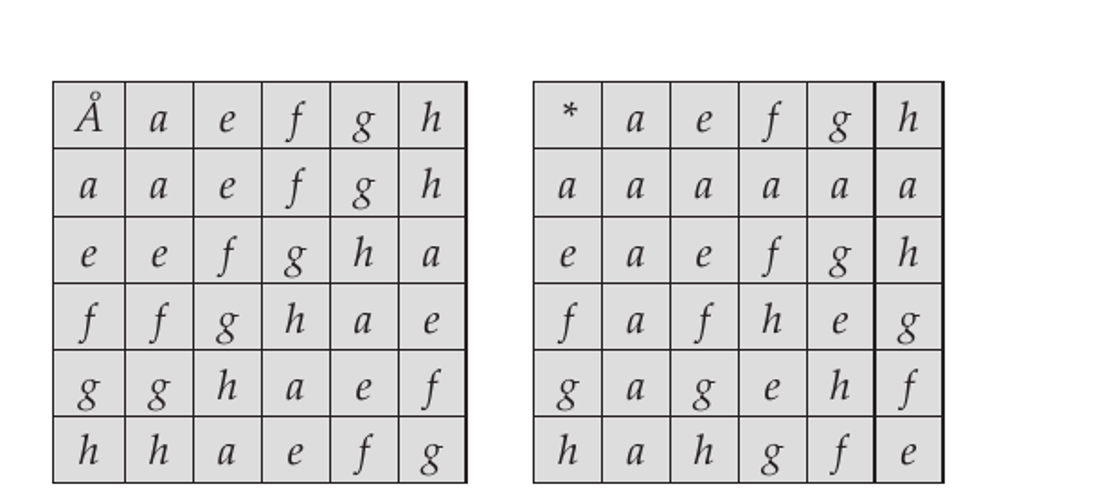
Thus, according to the first table f ⊕ g = a, while according to the second table g ∗ h = f, and so on. Also, let f² = f ∗ f, g³ = g ∗ g ∗ g, and so on. What is the smallest positive integer n such that gⁿ = e?
- (1) 4
- (2) 5
- (3) 2
- (4) 3
Show solution
For a positive integer n, let Pₙ denote the product of the digits of n, and Sₙ denote the sum of the digits of n. The number of integers between 10 and 1000 for which Pₙ + Sₙ = n is
- (1) 81
- (2) 16
- (3) 18
- (4) 9
Show solution
The sum of four consecutive two digit odd numbers, when divided by 10, becomes a perfect square. Which of the following can possibly be one of these four numbers?
- (1) 21
- (2) 25
- (3) 41
- (4) 67
Show solution
The number of employees in Obelix Menhir Co. is a prime number and is less than 300. The ratio of the number of employees who are graduates and above, to that of employees who are not, can possibly be
- (1) 101 : 88
- (2) 87 : 100
- (3) 110 : 111
- (4) 85 : 98
- (5) 97 : 84
Show solution
How many pairs of positive integers m, n satisfy 1/m + 4/n = 1/12 where n is an odd integer less than 60?
- (1) 6
- (2) 4
- (3) 7
- (4) 5
- (5) 3
Show solution
If the product of three consecutive positive integers is 15600 then the sum of the squares of these integers is
- (1) 1777
- (2) 1785
- (3) 1875
- (4) 1877
Show solution
How many different pairs (a, b) of positive integers are there such that a ≥ b and 1/a + 1/b = 1/9?
Show solution
The number of integers x such that 0.25 ≤ 2ˣ ≤ 200, and 2ˣ⁺² is perfectly divisible by either 3 or 4, is
Show solution
While multiplying three real numbers, Ashok took one of the numbers as 73 instead of 37. As a result, the product went up by 720. Then the minimum possible value of the sum of squares of the other two numbers is
Show solution
If the sum of squares of two numbers is 97, then which one of the following cannot be their product?
- (1) −32
- (2) 16
- (3) 48
- (4) 64
Show solution
The smallest integer n for which 4ⁿ > 17¹⁹ holds, is closest to
- (1) 37
- (2) 35
- (3) 33
- (4) 39
Show solution
How many pairs (m, n) of positive integers satisfy the equation m² + 105 = n²?
Show solution
In a six-digit number, the sixth, that is, the rightmost, digit is the sum of the first three digits, the fifth digit is the sum of first two digits, the third digit is equal to the first digit, the second digit is twice the first digit and the fourth digit is the sum of fifth and sixth digits. Then, the largest possible value of the fourth digit is
Show solution
If a, b, c are non-zero and 14ᵃ = 36ᵇ = 84ᶜ, then 6b(1/c − 1/a) is equal to
Show solution
Let N, x and y be positive integers such that N = x + y, 2 < x < 10 and 14 < y < 23. If N > 25, then how many distinct values are possible for N?
Show solution
If a, b and c are positive integers such that ab = 432, bc = 96 and c < 9, then the smallest possible value of a + b + c is
- (1) 46
- (2) 56
- (3) 49
- (4) 59
Show solution
A gentleman decided to treat a few children in the following manner. He gives half of his total stock of toffees and one extra to the first child, and then the half of the remaining stock along with one extra to the second and continues giving away in this fashion. His total stock exhausts after he takes care of 5 children. How many toffees were there in his stock initially?
Show solution
The mean of all 4-digit even natural numbers of the form 'aabb', where a > 0, is
- (1) 4864
- (2) 5050
- (3) 5544
- (4) 4466
Show solution
Let A, B and C be three positive integers such that the sum of A and the mean of B and C is 5. In addition, the sum of B and the mean of A and C is 7. Then the sum of A and B is:
- (1) 6
- (2) 7
- (3) 5
- (4) 4
Show solution
The number of groups of three or more distinct numbers that can be chosen from 1, 2, 3, 4, 5, 6, 7 and 8 so that the groups always include 3 and 5, while 7 and 8 are never included together is
Show solution
The natural numbers are divided into groups (1), (2, 3, 4), (5, 6, 7, 8, 9), …. and so on. Then, the sum of the numbers in the 15th group is equal to
- (1) 4941
- (2) 6090
- (3) 6119
- (4) 7471
Show solution
In a football tournament, a player has played a certain number of matches and 10 more matches are to be played. If he scores a total of one goal over the next 10 matches, his overall average will be 0.15 goals per match. On the other hand, if he scores a total of two goals over the next 10 matches, his overall average will be 0.2 goals per match. The number of matches he has played is
Show solution
Let a and b be natural numbers. If a² + ab + a = 14 and b² + ab + b = 28, then (2a + b) equals:
- (1) 8
- (2) 9
- (3) 7
- (4) 10
Show solution
The number of integers greater than 2000 that can be formed with the digits 0, 1, 2, 3, 4, 5, using each digit at most once, is
- (1) 1480
- (2) 1440
- (3) 1200
- (4) 1420
Show solution
For any real number x, let [x] be the largest integer less than or equal to x. If Σ (n = 1 to N) ⌊1/5 + n/25⌋ = 25, then N is
Show solution
If x and y are real numbers such that x² + (x − 2y − 1)² = −4y(x + y), then the value x − 2y is
- (1) 1
- (2) 2
- (3) −1
- (4) 0
Show solution
If √(5x + 9) + √(5x − 9) = 3(2 + √2), then √(10x + 9) =
- (1) 3√31
- (2) 2√7
- (3) 3√7
- (4) 4√5
Show solution
The number of all natural numbers up to 1000 with non-repeating digits is
- (1) 738
- (2) 648
- (3) 504
- (4) 585
Show solution
The population of a town in 2020 was 1,00,000. The population decreased by y% from the year 2020 to 2021, and increased by x% from the year 2021 to 2022, where x and y are two natural numbers. If population in 2022 was greater than the population in 2020 and the difference between x and y is 10, then the lowest possible population of the town in 2021 was
- (1) 73,000
- (2) 75,000
- (3) 74,000
- (4) 72,000
Show solution
Any non-zero real numbers x, y such that y ≠ 3 and x/y < (x + 3)/(y − 3), will satisfy the condition
- (1) If y > 10, then −x > y
- (2) x/y < y/x
- (3) If x < 0, then −x < y
- (4) If y < 0, then −x < y
Show solution
The value of 1 + (1 + 1/3)·(1/4) + (1 + 1/3 + 1/9)·(1/16) + (1 + 1/3 + 1/9 + 1/27)·(1/64) + …, is
- (1) 15/8
- (2) 15/13
- (3) 16/11
- (4) 27/12
Show solution
CAT 2024 & 2025, recent
The sum of all four-digit numbers that can be formed with the distinct non-zero digits a, b, c, and d, with each digit appearing exactly once in every number, is 153310 + n, where n is a single digit natural number. Then, the value of (a + b + c + d + n) is
Show solution
For any natural number n, let aₙ be the largest integer not exceeding √n. Then the value of a₁ + a₂ + … + a₅₀ is
Show solution
A shop wants to sell a certain quantity (in kg) of grains. It sells half the quantity and an additional 3 kg of these grains to the first customer. Then, it sells half of the remaining quantity and an additional 3 kg of these grains to the second customer. Finally, when the shop sells half of the remaining quantity and an additional 3 kg of these grains to the third customer, there are no grains left. The initial quantity, in kg, of grains is
- (A) 50
- (B) 36
- (C) 42
- (D) 18
Show solution
Find the sum of digits of the number 625⁶⁵ × 128³⁶.
- (A) 20
- (B) 25
- (C) 30
- (D) 35
- (E) 40
Show solution
If 12¹²ˣ × 4²⁴ˣ⁺¹² × 5²ʸ = 8⁴ᶻ × 20¹²ˣ × 243³ˣ⁻⁶, where x, y and z are natural numbers, then x + y + z equals
Show solution
The sum of all the digits of the number (10⁵⁰ + 10²⁵ − 123), is
- (A) 21
- (B) 221
- (C) 324
- (D) 255
Show solution
For a 4-digit number (greater than 1000), sum of the digits in the thousands, hundreds, and tens places is 15. Sum of the digits in the hundreds, tens, and units places is 16. Also, the digit in the tens place is 6 more than the digit in the units place. The difference between the largest and smallest possible value of the number is:
- (A) 811
- (B) 735
- (C) 3289
- (D) 4078