Mensuration, 2D , formulas + CAT PYQs
Focused Geometry kit. The full chapter formula sheet (with explanations & basic examples) is tucked below; every CAT PYQ for Mensuration, 2D is here.
Geometry, formula sheet
Show the full Geometry formula sheet (explanations + basic examples)
- The starting toolkit: most "find the angle" questions are solved just by knowing angles on a line make 180° and walking that around the figure.
- Angles on a straight line add to 180°; angles around a point add to 360°.
- Vertically opposite angles are equal.
- Parallel lines cut by a transversal: corresponding & alternate angles equal; co-interior angles sum to 180°.
- Exterior angle of a triangle = sum of the two remote interior angles.
- e.g. Two angles sit on a straight line and one is 110°. The other = 180° − 110° = 70°.
- Pick the area formula that matches what you're given: base+height, all three sides (Heron), or two sides and the angle between them.
- Angle sum = 180°. Sum of any two sides > the third side.
- Area = ½ × base × height.
- Heron: Area = √[s(s−a)(s−b)(s−c)], s = (a+b+c)/2.
- Area = ½·a·b·sinθ (θ = included angle); Area = r × s (r = inradius); Area = abc/(4R) (R = circumradius).
- e.g. Sides 3, 4, 5: s = 6, Area = √[6·3·2·1] = √36 = 6 (matches ½·3·4).
- Cosine rule links three sides and one angle (use when you have two sides + included angle, or all three sides); sine rule links sides to opposite angles.
- Cosine rule: c² = a² + b² − 2ab·cosθ.
- cosθ = (a² + b² − c²)/(2ab).
- Sine rule: a/sinA = b/sinB = c/sinC = 2R.
- e.g. Sides 5 and 8 with a 60° angle between them: third side² = 25 + 64 − 2·5·8·½ = 89 − 40 = 49 ⇒ side = 7.
- A bisector splits the far side in the ratio of the two sides it sits between; a median goes to the midpoint, and the centroid cuts it 2:1.
- Angle bisector divides the opposite side in the ratio of the adjacent sides: BD/DC = AB/AC.
- Apollonius: b² + c² = 2m² + ½a² (m = median to side a).
- Median of isosceles (b = c): m² = b² − a²/4.
- Centroid divides each median in ratio 2 : 1 from the vertex.
- e.g. AB = 6, AC = 4, bisector meets BC (length 5) at D: BD:DC = 6:4 = 3:2 ⇒ BD = 3, DC = 2.
- In a right triangle the squares of the legs add to the square of the hypotenuse; memorising the triplets saves time in the exam.
- Right triangle: hypotenuse² = base² + height².
- Altitude to hypotenuse (AD⊥BC, right-angled at A): AD² = BD·DC, AB² = BD·BC, AC² = CD·BC.
- Acute: AC² = AB² + BC² − 2·BC·BD; Obtuse: AC² = AB² + BC² + 2·BC·BD.
- Triplets: 3-4-5, 5-12-13, 8-15-17, 7-24-25.
- e.g. Legs 6 and 8: hypotenuse = √(36 + 64) = √100 = 10 (a scaled 3-4-5).
- Congruent = identical; similar = same shape, scaled. The big CAT lever is that areas of similar figures scale as the square of the side ratio.
- Congruence: SSS, SAS, ASA, AAS, RHS.
- Similarity: AA, SSS, SAS. Corresponding sides are proportional.
- Basic Proportionality (Thales): a line ∥ to one side cuts the others in equal ratios.
- Ratio of areas of similar triangles = (ratio of sides)².
- e.g. Two similar triangles with sides in ratio 2:3 have areas in ratio 4:9. If the smaller has area 8, the larger = 18.
- Equilateral and the two "set-square" triangles (30-60-90, 45-45-90) have fixed side ratios, recognise them and you can write down sides instantly.
- Equilateral side a: Area = (√3/4)a², height = (√3/2)a, R = a/√3, r = a/(2√3).
- 30-60-90 sides ratio 1 : √3 : 2.
- 45-45-90 sides ratio 1 : 1 : √2.
- From an interior point of an equilateral triangle, sum of ⊥s to the three sides = its height.
- e.g. Equilateral triangle of side 4: area = (√3/4)·16 = 4√3 and height = (√3/2)·4 = 2√3.
- Four "centres", each the meeting point of a different set of cevians; the incentre and circumcentre are the ones that show up most in area/radius questions.
- Centroid, intersection of medians (2:1).
- Incentre, intersection of angle bisectors, centre of inscribed circle.
- Circumcentre, intersection of ⊥ bisectors of sides, centre of circumscribed circle.
- Orthocentre, intersection of altitudes.
- e.g. In a right triangle the circumcentre is the midpoint of the hypotenuse, so a 6-8-10 triangle has circumradius = 10/2 = 5.
- Two workhorses: the angle at the centre is twice the angle at the rim on the same arc, and any angle drawn on a diameter is a right angle.
- Circumference = 2πr; Area = πr².
- Equal chords subtend equal angles at the centre & are equidistant from it.
- ⊥ from the centre bisects the chord.
- Angle at the centre = 2 × angle at the circumference on the same arc.
- Angle in a semicircle = 90°.
- e.g. An arc subtends 40° at the centre, so it subtends 40°/2 = 20° at any point on the major arc.
- "Power of a point": from any point, the products of the two distances to the circle along a line are equal, chords, secants and tangents all obey it.
- Two chords meeting at P: PA·PB = PC·PD.
- Tangent-secant from external P: PA·PB = PT².
- Tangent ⊥ radius at the point of contact; tangents from an external point are equal.
- Alternate segment theorem: tangent-chord angle = angle in the alternate segment.
- e.g. Two chords cross with parts 3 & 8 on one and 4 & x on the other: 3·8 = 4·x ⇒ x = 6.
- If all four corners lie on a circle, opposite angles are supplementary; the tangent formulas give the straight-line distance between two circles' touch points.
- Cyclic quad: opposite angles sum to 180°; exterior angle = opposite interior angle.
- Ptolemy: AB·CD + BC·DA = AC·BD.
- A parallelogram inscribed in a circle is a rectangle.
- Direct common tangent = √[d² − (r₁−r₂)²]; Transverse = √[d² − (r₁+r₂)²].
- e.g. In a cyclic quad one angle is 70°, so its opposite angle = 180° − 70° = 110°.
- Each special quadrilateral has its own area shortcut, base×height for parallelograms, half-product of diagonals for a rhombus, average of parallel sides times height for a trapezium.
- Parallelogram: opposite sides & angles equal; diagonals bisect each other. Area = base × height.
- Rectangle: all angles 90°, diagonals equal. Square: all sides equal + 90°.
- Rhombus: all sides equal; diagonals ⊥ & bisect each other. Area = ½·d₁·d₂.
- Trapezium: one pair of parallel sides. Area = ½(sum of parallel sides) × height.
- e.g. Rhombus with diagonals 6 and 8: area = ½·6·8 = 24; trapezium with parallel sides 5 & 9, height 4: area = ½·(5+9)·4 = 28.
- Everything flows from "(n−2)·180° of total interior angle"; for a regular polygon the quick route is via the exterior angle, which is just 360°/n.
- Sum of interior angles = (n − 2)·180°.
- Each interior angle (regular) = 180° − 360°/n.
- Each exterior angle (regular) = 360°/n; all exterior angles sum to 360°.
- Number of diagonals = n(n − 3)/2.
- e.g. A regular hexagon (n = 6): each exterior angle = 360°/6 = 60°, so each interior angle = 120°; diagonals = 6·3/2 = 9.
- Think of it as 6 equilateral triangles glued at the centre, that single picture gives its area, diagonals and angles.
- Side s: Area = (3√3/2)·s².
- It is 6 equilateral triangles of side s.
- Longer diagonal = 2s; shorter diagonal = √3·s.
- Interior angle = 120°.
- e.g. Hexagon of side 2: area = (3√3/2)·4 = 6√3; long diagonal = 4, short diagonal = 2√3.
- The basic flat-shape formulas; a sector is just a fraction θ/360 of the whole circle for both its arc and its area.
- Square: P = 4a, Area = a², diagonal = a√2.
- Rectangle: P = 2(l+b), Area = l·b, diagonal = √(l²+b²).
- Circle: C = 2πr, Area = πr².
- Sector (angle θ): arc = (θ/360)·2πr, area = (θ/360)·πr².
- e.g. A 90° sector of a radius-6 circle is ¼ of it: area = ¼·π·36 = 9π, arc = ¼·2π·6 = 3π.
- A cube is just a cuboid with l = b = h; the space diagonal (corner-to-corner through the body) uses a 3-term Pythagoras.
- Cuboid: Volume = l·b·h; TSA = 2(lb + bh + hl); LSA (4 walls) = 2(l+b)h; diagonal = √(l²+b²+h²).
- Cube edge a: Volume = a³; TSA = 6a²; LSA = 4a²; diagonal = a√3.
- Sum of all 12 edges: cuboid 4(l+b+h), cube 12a.
- e.g. Cube of edge 3: volume = 27, TSA = 6·9 = 54, space diagonal = 3√3; a 2×3×6 cuboid has diagonal √(4+9+36) = √49 = 7.
- A cone holds exactly one-third of the cylinder with the same base and height; its slant height is the hypotenuse of the radius-and-height right triangle.
- Cylinder: Volume = πr²h; CSA = 2πrh; TSA = 2πr(r+h).
- Cone slant l = √(r²+h²); Volume = ⅓πr²h; CSA = πrl; TSA = πr(r+l).
- Frustum volume = ⅓πh(R² + r² + Rr).
- e.g. Cone with r = 3, h = 4: slant = √(9+16) = 5, CSA = π·3·5 = 15π, volume = ⅓·π·9·4 = 12π.
- The key exam idea is "recasting": when one solid is melted into another, volume stays the same even though surface area changes.
- Sphere: Volume = (4/3)πr³; Surface area = 4πr².
- Hemisphere: Volume = (2/3)πr³; CSA = 2πr²; TSA = 3πr².
- Prism: Volume = base area × height; LSA = base perimeter × height.
- Recast objects keep volume constant.
- e.g. Sphere of radius 3: volume = (4/3)·π·27 = 36π, surface area = 4·π·9 = 36π.
- Distance is just Pythagoras on the coordinate differences; the midpoint is the special case of the section formula with ratio 1:1.
- Distance = √[(x₂−x₁)² + (y₂−y₁)²].
- Midpoint = ((x₁+x₂)/2, (y₁+y₂)/2).
- Section (ratio m:n internal) = ((mx₂+nx₁)/(m+n), (my₂+ny₁)/(m+n)).
- Centroid = ((x₁+x₂+x₃)/3, (y₁+y₂+y₃)/3).
- e.g. Distance from (1, 2) to (4, 6) = √(3² + 4²) = 5; their midpoint = (2.5, 4).
- Slope = rise over run. Equal slopes mean parallel; slopes multiplying to −1 mean perpendicular. The area formula needs only the three vertices.
- Area = ½|x₁(y₂−y₃) + x₂(y₃−y₁) + x₃(y₁−y₂)|.
- Slope of line through two points m = (y₂−y₁)/(x₂−x₁).
- Parallel lines: m₁ = m₂. Perpendicular: m₁·m₂ = −1.
- e.g. Triangle (0,0), (4,0), (0,3): area = ½|0(0−3)+4(3−0)+0| = ½·12 = 6.
- For the general circle, halve the x- and y-coefficients (with a sign flip) to read off the centre, then back out the radius.
- Slope-intercept: y = mx + c. Point-slope: y − y₁ = m(x − x₁).
- ⊥ distance of (x₁,y₁) from ax+by+c=0 = |ax₁+by₁+c|/√(a²+b²).
- Distance between parallel lines = |c₂−c₁|/√(a²+b²).
- Circle: (x−h)² + (y−k)² = r²; general x²+y²+2gx+2fy+c=0, centre (−g,−f), r = √(g²+f²−c).
- e.g. Distance of (0,0) from 3x + 4y − 10 = 0 = |−10|/√(9+16) = 10/5 = 2.
Mensuration, 2D, CAT PYQs
Mensuration, 2D
Four identical coins are placed in a square. For each coin the ratio of area to circumference is same as the ratio of circumference to area. Then find the area of the square that is not covered by the coins.
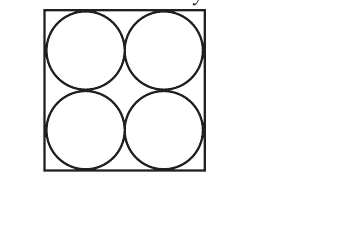
- (1) 16(π − 1)
- (2) 16(8 − π)
- (3) 16(4 − π)
- (4) 16(4 − π/2)
Show solution
Consider two different cloth-cutting processes. In the first one, n circular cloth pieces are cut from a square cloth piece of side a in the following steps: The original square of side a is divided into n smaller squares, not necessarily of the same size; then a circle of maximum possible area is cut from each of the smaller squares. In the second process, only one circle of maximum possible area is cut from the square of side a and the process ends there. The cloth pieces remaining after cutting the circles are scrapped in both the processes. The ratio of the total area of scrap cloth generated in the former to that in the latter is:
- (1) 1 : 1
- (2) 2 : 1
- (3) n(4 − π)/(4n − π)
- (4) (4n − π)/n(4 − π)
Show solution
A jogging park has two identical circular tracks touching each other, and a rectangular track enclosing the two circles. The edges of the rectangles are tangential to the circles. Two friends, A and B, start jogging simultaneously from the point where one of the circular tracks touches the smaller side of the rectangular track. A jog along the rectangular track, while B jogs along the two circular tracks in a figure of eight. Approximately, how much faster than A does B have to run, so that they take the same time to return to their starting point?
- (1) 3.88%
- (2) 4.22%
- (3) 4.44%
- (4) 4.72%
Show solution
Rectangular tiles each of size 70 cm by 30 cm must be laid horizontally on a rectangular floor of size 110 cm by 130 cm, such that the tiles do not overlap. A tile can be placed in any orientation so long as its edges are parallel to the edges of the floor. No tile should overshoot any edge of the floor. The maximum number of tiles that can be accommodated on the floor is:
- (1) 4
- (2) 5
- (3) 6
- (4) 7
Show solution
From a rectangle ABCD of area 768 sq cm, a semicircular part with diameter AB and area 72π sq cm is removed. The perimeter of the leftover portion, in cm, is:
- (1) 80 + 16π
- (2) 86 + 8π
- (3) 88 + 12π
- (4) 82 + 24π
Show solution
On a rectangular metal sheet of area 135 sq inch, a circle is painted such that the circle touches two opposite sides. If the area of the sheet left unpainted is two-thirds of the painted area then the perimeter of the rectangle in inches is:
- (1) 5√π(3 + 9/π)
- (2) 3√π(5 + 12/π)
- (3) 4√π(3 + 9/π)
- (4) 3√π(5/2 + 6/π)
Show solution
The sum of the perimeters of an equilateral triangle and a rectangle is 90 cm. The area, T, of the triangle and the area, R, of the rectangle, both in sq cm, satisfy the relationship R = T². If the sides of the rectangle are in the ratio 1 : 3, then the length, in cm, of the longer side of the rectangle, is:
- (1) 18
- (2) 27
- (3) 21
- (4) 24
Show solution
CAT 2024 & 2025, recent
In the XY-plane, the area, in sq. units, of the region defined by the inequalities y ≥ x + 4 and −4 ≤ x² + y² + 4(x − y) ≤ 0 is
- (A) 2π
- (B) 4π
- (C) π
- (D) 3π