Circles , formulas + CAT PYQs
Focused Geometry kit. The full chapter formula sheet (with explanations & basic examples) is tucked below; every CAT PYQ for Circles is here.
Geometry, formula sheet
Show the full Geometry formula sheet (explanations + basic examples)
- The starting toolkit: most "find the angle" questions are solved just by knowing angles on a line make 180° and walking that around the figure.
- Angles on a straight line add to 180°; angles around a point add to 360°.
- Vertically opposite angles are equal.
- Parallel lines cut by a transversal: corresponding & alternate angles equal; co-interior angles sum to 180°.
- Exterior angle of a triangle = sum of the two remote interior angles.
- e.g. Two angles sit on a straight line and one is 110°. The other = 180° − 110° = 70°.
- Pick the area formula that matches what you're given: base+height, all three sides (Heron), or two sides and the angle between them.
- Angle sum = 180°. Sum of any two sides > the third side.
- Area = ½ × base × height.
- Heron: Area = √[s(s−a)(s−b)(s−c)], s = (a+b+c)/2.
- Area = ½·a·b·sinθ (θ = included angle); Area = r × s (r = inradius); Area = abc/(4R) (R = circumradius).
- e.g. Sides 3, 4, 5: s = 6, Area = √[6·3·2·1] = √36 = 6 (matches ½·3·4).
- Cosine rule links three sides and one angle (use when you have two sides + included angle, or all three sides); sine rule links sides to opposite angles.
- Cosine rule: c² = a² + b² − 2ab·cosθ.
- cosθ = (a² + b² − c²)/(2ab).
- Sine rule: a/sinA = b/sinB = c/sinC = 2R.
- e.g. Sides 5 and 8 with a 60° angle between them: third side² = 25 + 64 − 2·5·8·½ = 89 − 40 = 49 ⇒ side = 7.
- A bisector splits the far side in the ratio of the two sides it sits between; a median goes to the midpoint, and the centroid cuts it 2:1.
- Angle bisector divides the opposite side in the ratio of the adjacent sides: BD/DC = AB/AC.
- Apollonius: b² + c² = 2m² + ½a² (m = median to side a).
- Median of isosceles (b = c): m² = b² − a²/4.
- Centroid divides each median in ratio 2 : 1 from the vertex.
- e.g. AB = 6, AC = 4, bisector meets BC (length 5) at D: BD:DC = 6:4 = 3:2 ⇒ BD = 3, DC = 2.
- In a right triangle the squares of the legs add to the square of the hypotenuse; memorising the triplets saves time in the exam.
- Right triangle: hypotenuse² = base² + height².
- Altitude to hypotenuse (AD⊥BC, right-angled at A): AD² = BD·DC, AB² = BD·BC, AC² = CD·BC.
- Acute: AC² = AB² + BC² − 2·BC·BD; Obtuse: AC² = AB² + BC² + 2·BC·BD.
- Triplets: 3-4-5, 5-12-13, 8-15-17, 7-24-25.
- e.g. Legs 6 and 8: hypotenuse = √(36 + 64) = √100 = 10 (a scaled 3-4-5).
- Congruent = identical; similar = same shape, scaled. The big CAT lever is that areas of similar figures scale as the square of the side ratio.
- Congruence: SSS, SAS, ASA, AAS, RHS.
- Similarity: AA, SSS, SAS. Corresponding sides are proportional.
- Basic Proportionality (Thales): a line ∥ to one side cuts the others in equal ratios.
- Ratio of areas of similar triangles = (ratio of sides)².
- e.g. Two similar triangles with sides in ratio 2:3 have areas in ratio 4:9. If the smaller has area 8, the larger = 18.
- Equilateral and the two "set-square" triangles (30-60-90, 45-45-90) have fixed side ratios, recognise them and you can write down sides instantly.
- Equilateral side a: Area = (√3/4)a², height = (√3/2)a, R = a/√3, r = a/(2√3).
- 30-60-90 sides ratio 1 : √3 : 2.
- 45-45-90 sides ratio 1 : 1 : √2.
- From an interior point of an equilateral triangle, sum of ⊥s to the three sides = its height.
- e.g. Equilateral triangle of side 4: area = (√3/4)·16 = 4√3 and height = (√3/2)·4 = 2√3.
- Four "centres", each the meeting point of a different set of cevians; the incentre and circumcentre are the ones that show up most in area/radius questions.
- Centroid, intersection of medians (2:1).
- Incentre, intersection of angle bisectors, centre of inscribed circle.
- Circumcentre, intersection of ⊥ bisectors of sides, centre of circumscribed circle.
- Orthocentre, intersection of altitudes.
- e.g. In a right triangle the circumcentre is the midpoint of the hypotenuse, so a 6-8-10 triangle has circumradius = 10/2 = 5.
- Two workhorses: the angle at the centre is twice the angle at the rim on the same arc, and any angle drawn on a diameter is a right angle.
- Circumference = 2πr; Area = πr².
- Equal chords subtend equal angles at the centre & are equidistant from it.
- ⊥ from the centre bisects the chord.
- Angle at the centre = 2 × angle at the circumference on the same arc.
- Angle in a semicircle = 90°.
- e.g. An arc subtends 40° at the centre, so it subtends 40°/2 = 20° at any point on the major arc.
- "Power of a point": from any point, the products of the two distances to the circle along a line are equal, chords, secants and tangents all obey it.
- Two chords meeting at P: PA·PB = PC·PD.
- Tangent-secant from external P: PA·PB = PT².
- Tangent ⊥ radius at the point of contact; tangents from an external point are equal.
- Alternate segment theorem: tangent-chord angle = angle in the alternate segment.
- e.g. Two chords cross with parts 3 & 8 on one and 4 & x on the other: 3·8 = 4·x ⇒ x = 6.
- If all four corners lie on a circle, opposite angles are supplementary; the tangent formulas give the straight-line distance between two circles' touch points.
- Cyclic quad: opposite angles sum to 180°; exterior angle = opposite interior angle.
- Ptolemy: AB·CD + BC·DA = AC·BD.
- A parallelogram inscribed in a circle is a rectangle.
- Direct common tangent = √[d² − (r₁−r₂)²]; Transverse = √[d² − (r₁+r₂)²].
- e.g. In a cyclic quad one angle is 70°, so its opposite angle = 180° − 70° = 110°.
- Each special quadrilateral has its own area shortcut, base×height for parallelograms, half-product of diagonals for a rhombus, average of parallel sides times height for a trapezium.
- Parallelogram: opposite sides & angles equal; diagonals bisect each other. Area = base × height.
- Rectangle: all angles 90°, diagonals equal. Square: all sides equal + 90°.
- Rhombus: all sides equal; diagonals ⊥ & bisect each other. Area = ½·d₁·d₂.
- Trapezium: one pair of parallel sides. Area = ½(sum of parallel sides) × height.
- e.g. Rhombus with diagonals 6 and 8: area = ½·6·8 = 24; trapezium with parallel sides 5 & 9, height 4: area = ½·(5+9)·4 = 28.
- Everything flows from "(n−2)·180° of total interior angle"; for a regular polygon the quick route is via the exterior angle, which is just 360°/n.
- Sum of interior angles = (n − 2)·180°.
- Each interior angle (regular) = 180° − 360°/n.
- Each exterior angle (regular) = 360°/n; all exterior angles sum to 360°.
- Number of diagonals = n(n − 3)/2.
- e.g. A regular hexagon (n = 6): each exterior angle = 360°/6 = 60°, so each interior angle = 120°; diagonals = 6·3/2 = 9.
- Think of it as 6 equilateral triangles glued at the centre, that single picture gives its area, diagonals and angles.
- Side s: Area = (3√3/2)·s².
- It is 6 equilateral triangles of side s.
- Longer diagonal = 2s; shorter diagonal = √3·s.
- Interior angle = 120°.
- e.g. Hexagon of side 2: area = (3√3/2)·4 = 6√3; long diagonal = 4, short diagonal = 2√3.
- The basic flat-shape formulas; a sector is just a fraction θ/360 of the whole circle for both its arc and its area.
- Square: P = 4a, Area = a², diagonal = a√2.
- Rectangle: P = 2(l+b), Area = l·b, diagonal = √(l²+b²).
- Circle: C = 2πr, Area = πr².
- Sector (angle θ): arc = (θ/360)·2πr, area = (θ/360)·πr².
- e.g. A 90° sector of a radius-6 circle is ¼ of it: area = ¼·π·36 = 9π, arc = ¼·2π·6 = 3π.
- A cube is just a cuboid with l = b = h; the space diagonal (corner-to-corner through the body) uses a 3-term Pythagoras.
- Cuboid: Volume = l·b·h; TSA = 2(lb + bh + hl); LSA (4 walls) = 2(l+b)h; diagonal = √(l²+b²+h²).
- Cube edge a: Volume = a³; TSA = 6a²; LSA = 4a²; diagonal = a√3.
- Sum of all 12 edges: cuboid 4(l+b+h), cube 12a.
- e.g. Cube of edge 3: volume = 27, TSA = 6·9 = 54, space diagonal = 3√3; a 2×3×6 cuboid has diagonal √(4+9+36) = √49 = 7.
- A cone holds exactly one-third of the cylinder with the same base and height; its slant height is the hypotenuse of the radius-and-height right triangle.
- Cylinder: Volume = πr²h; CSA = 2πrh; TSA = 2πr(r+h).
- Cone slant l = √(r²+h²); Volume = ⅓πr²h; CSA = πrl; TSA = πr(r+l).
- Frustum volume = ⅓πh(R² + r² + Rr).
- e.g. Cone with r = 3, h = 4: slant = √(9+16) = 5, CSA = π·3·5 = 15π, volume = ⅓·π·9·4 = 12π.
- The key exam idea is "recasting": when one solid is melted into another, volume stays the same even though surface area changes.
- Sphere: Volume = (4/3)πr³; Surface area = 4πr².
- Hemisphere: Volume = (2/3)πr³; CSA = 2πr²; TSA = 3πr².
- Prism: Volume = base area × height; LSA = base perimeter × height.
- Recast objects keep volume constant.
- e.g. Sphere of radius 3: volume = (4/3)·π·27 = 36π, surface area = 4·π·9 = 36π.
- Distance is just Pythagoras on the coordinate differences; the midpoint is the special case of the section formula with ratio 1:1.
- Distance = √[(x₂−x₁)² + (y₂−y₁)²].
- Midpoint = ((x₁+x₂)/2, (y₁+y₂)/2).
- Section (ratio m:n internal) = ((mx₂+nx₁)/(m+n), (my₂+ny₁)/(m+n)).
- Centroid = ((x₁+x₂+x₃)/3, (y₁+y₂+y₃)/3).
- e.g. Distance from (1, 2) to (4, 6) = √(3² + 4²) = 5; their midpoint = (2.5, 4).
- Slope = rise over run. Equal slopes mean parallel; slopes multiplying to −1 mean perpendicular. The area formula needs only the three vertices.
- Area = ½|x₁(y₂−y₃) + x₂(y₃−y₁) + x₃(y₁−y₂)|.
- Slope of line through two points m = (y₂−y₁)/(x₂−x₁).
- Parallel lines: m₁ = m₂. Perpendicular: m₁·m₂ = −1.
- e.g. Triangle (0,0), (4,0), (0,3): area = ½|0(0−3)+4(3−0)+0| = ½·12 = 6.
- For the general circle, halve the x- and y-coefficients (with a sign flip) to read off the centre, then back out the radius.
- Slope-intercept: y = mx + c. Point-slope: y − y₁ = m(x − x₁).
- ⊥ distance of (x₁,y₁) from ax+by+c=0 = |ax₁+by₁+c|/√(a²+b²).
- Distance between parallel lines = |c₂−c₁|/√(a²+b²).
- Circle: (x−h)² + (y−k)² = r²; general x²+y²+2gx+2fy+c=0, centre (−g,−f), r = √(g²+f²−c).
- e.g. Distance of (0,0) from 3x + 4y − 10 = 0 = |−10|/√(9+16) = 10/5 = 2.
Circles, CAT PYQs
Circles
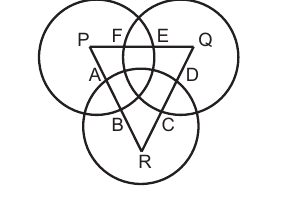
Three circles, each of radius 20, have centres at P, Q and R. Further, AB = 5, CD = 10 and EF = 12. What is the perimeter of ∆PQR?
- (1) 120
- (2) 66
- (3) 93
- (4) 87
Show solution
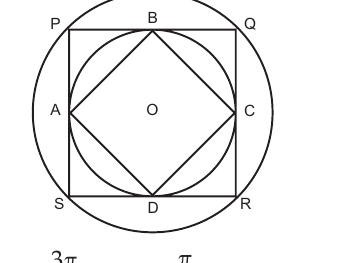
The figure below shows two concentric circles with centre O. PQRS is a square inscribed in the outer circle. It also circumscribes the inner circle, touching it at points B, C, D and A. What is the ratio of the perimeter of the outer circle to that of polygon ABCD?
- (1) π/4
- (2) 3π/2
- (3) π/2
- (4) π
Show solution
Consider a circle with unit radius. There are seven adjacent sectors, S₁, S₂, S₃, …, S₇, in the circle such that their total area is 1/8 of the area of the circle. Further, the area of the jth sector is twice that of the (j − 1)th sector, for j = 2, …, 7. What is the angle, in radians, subtended by the arc of S₁ at the centre of the circle?
- (1) π/508
- (2) π/2040
- (3) π/1016
- (4) π/1524
Show solution
A certain city has a circular wall around it, and this wall has four gates pointing north, south, east and west. A house stands outside the city, three km north of the north gate, and it can just be seen from a point nine km east of the south gate. What is the diameter of the wall what surrounds the city?
- (1) 6 km
- (2) 9 km
- (3) 12 km
- (4) None of these
Show solution
There is a common chord of 2 circles with radius 15 and 20. The distance between the two centres is 25. The length of the chord is
- (1) 48
- (2) 24
- (3) 36
- (4) 28
Show solution
There are two concentric circles such that the area of the outer circle is four times the area of the inner circle. Let A, B and C be three distinct points on the perimeter of the outer circle such that AB and AC are tangents to the inner circle. If the area of the outer circle is 12 square centimetres then the area (in square centimetres) of the triangle ABC would be___.
- (1) π√12
- (2) 9/π
- (3) 9√3/π
- (4) 6√3/π
Show solution
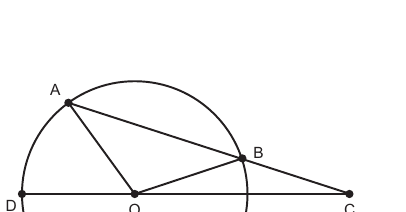
In the figure given below, AB is the chord of a circle with centre O. AB is extended to C such that BC = OB. The straight line CO is produced to meet the circle at D. If ∠ACD = y° and ∠AOD = x° such that x = ky, then the value of k is___.
- (1) 3
- (2) 2
- (3) 1
- (4) None of these
Show solution
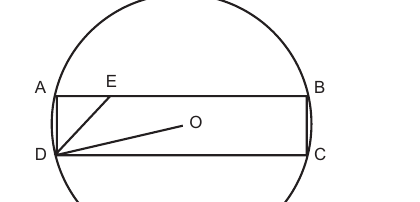
In the figure below (not drawn to scale), rectangle ABCD is inscribed in the circle with centre at O. The length of side AB is greater than that of side BC. The ratio of the area of the circle to the area of the rectangle ABCD is π : √3. The line segment DE intersects AB at E such that ∠ODC = ∠ADE. What is the ratio of AE : AD?
- (1) 1 : √3
- (2) 1 : √2
- (3) 1 : 2√3
- (4) 1 : 2
Show solution
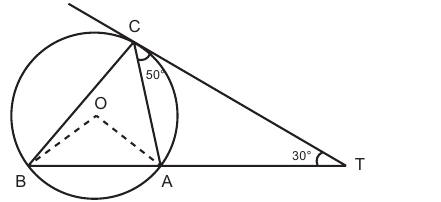
In the figure given below (not drawn to scale), A, B and C are three points on a circle with centre O. The chord BA is extended to a point T such that CT becomes a tangent to the circle at point C. If ∠ATC = 30° and ∠ACT = 50°, then the angle ∠BOA is
- (1) 100°
- (2) 150°
- (3) 80°
- (4) Cannot be determined
Show solution
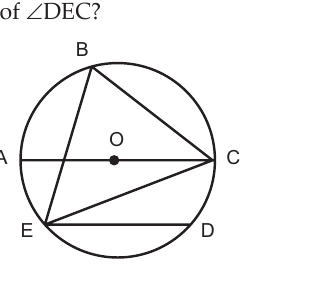
In the adjoining figure, chord ED is parallel to the diameter AC of the circle. If ∠CBE = 65°, then what is the value of ∠DEC?
- (1) 35°
- (2) 55°
- (3) 45°
- (4) 25°
Show solution
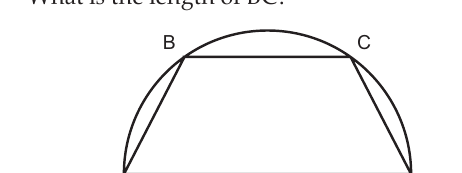
On a semicircle with diameter AD, chord BC is parallel to the diameter. Further, each of the chords AB and CD has length 2, while AD has length 8. What is the length of BC?
- (1) 7.5
- (2) 7
- (3) 7.75
- (4) None of these
Show solution
Let C be a circle with centre P₀ and AB be a diameter of C. Suppose P₁ is the mid-point of the line segment P₀B, P₂ is the mid-point of the line segment P₁B and so on. Let C₁, C₂, C₃, …… be circles with diameters P₀P₁, P₁P₂, P₂P₃ … respectively. Suppose the circles C₁, C₂, C₃, …. are all shaded. The ratio of the area of the unshaded portion of C to that of the original circle C is
- (1) 8 : 9
- (2) 9 : 10
- (3) 10 : 11
- (4) 11 : 12
Show solution
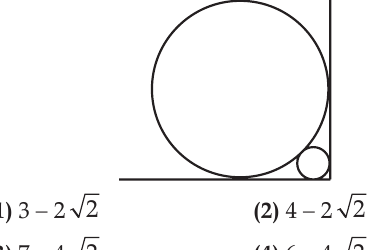
A circle with radius 2 is placed against a right angle. Another smaller circle is also placed as shown in the adjoining figure. What is the radius of the smaller circle?
- (1) 3 − 2√2
- (2) 4 − 2√2
- (3) 7 − 4√2
- (4) 6 − 4√2
Show solution
What is the distance in cm between two parallel chords of lengths 32 cm and 24 cm in a circle of radius 20 cm?
- (1) 1 or 7
- (2) 2 or 14
- (3) 3 or 21
- (4) 4 or 28
Show solution
Four points A, B, C and D lie on a straight line in the X-Y plane, such that AB = BC = CD, and the length of AB is 1 metre. An ant at A wants to reach a sugar particle at D. But there are insect repellents kept at points B and C. The ant would not go within one metre of any insect repellent. The minimum distance in metres the ant must traverse to reach the sugar particle is
- (1) 3√2
- (2) 1 + π
- (3) 4π/3
- (4) 5
Show solution
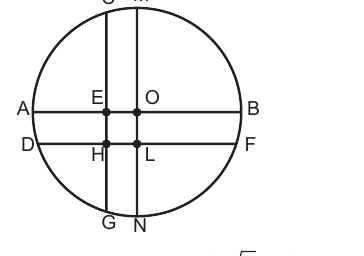
In the following figure, the diameter of the circle is 3 cm. AB and MN are two diameters such that MN is perpendicular to AB. In addition, CG is perpendicular to AB such that AE : EB = 1 : 2, and DF is perpendicular to MN such that NL : LM = 1 : 2. The length of DH in cm is
- (1) 2√2 − 1
- (2) (2√2 − 1)/2
- (3) (3√2 − 1)/2
- (4) (2√2 − 1)/3
Show solution
Two identical circles intersect so that their centres, and the points at which they intersect, form a square of side 1 cm. The area in sq. cm of the portion that is common to the two circles is:
- (1) π/4
- (2) π/2 − 1
- (3) π/5
- (4) √2 − 1
Show solution
A semi-circle is drawn with AB as its diameter. From C, a point on AB, a line perpendicular to AB is drawn meeting the circumference of the semi-circle at D. Given that AC = 2 cm and CD = 6 cm, the area of the semi-circle (in sq. cm.) will be:
- (1) 32π
- (2) 50π
- (3) 40.5π
- (4) 81π
Show solution
P, Q, S, and R are points on the circumference of a circle of radius r, such that PQR is an equilateral triangle and PS is a diameter of the circle. What is the perimeter of the quadrilateral PQSR?
- (1) 2r(1 + √3)
- (2) 2r(2 + √3)
- (3) r(1 + √5)
- (4) 2r + √3
Show solution
Two circles with centres P and Q cut each other at two distinct points A and B. The circles have the same radii and neither P nor Q falls within the intersection of the circles. What is the smallest range that includes all possible values of the angle AQP in degrees?
- (1) Between 0 and 90
- (2) Between 0 and 30
- (3) Between 0 and 60
- (4) Between 0 and 75
Show solution
Two circles, both of radii 1 cm, intersect such that the circumference of each one passes through the centre of the circle of the other. What is the area (in sq cm) of the intersecting region?
- (1) π/3 − √3/4
- (2) 3π/3 + √3/2
- (3) 4π/3 − √3/2
- (4) 2π/3 − √3/2
Show solution
ABCD is a quadrilateral inscribed in a circle with centre O. If ∠COD = 120 degrees and ∠BAC = 30 degrees, then the value of ∠BCD (in degrees) is
Show solution
Let ABC be a right-angled isosceles triangle with hypotenuse BC. Let BQC be a semi-circle, away from A, with diameter BC. Let BPC be an arc of a circle centered at A and lying between BC and BQC. If AB has length 6 cm then the area, in sq cm, of the region enclosed by BPC and BQC is
- (1) 9π − 18
- (2) 18
- (3) 9π
- (4) 9
Show solution
In a circle, two parallel chords on the same side of a diameter have lengths 4 cm and 6 cm. If the distance between these chords is 1 cm, then the radius of the circle, in cm, is
- (1) √13
- (2) √14
- (3) √11
- (4) √12
Show solution
In a circle with center O and radius 1 cm, an arc AB makes an angle 60 degrees at O. Let R be the region bounded by the radii OA, OB and the arc AB. If C and D are two points on OA and OB, respectively, such that OC = OD and the area of triangle OCD is half that of R, then the length of OC, in cm, is
- (1) (π/4√3)½
- (2) (π/6)½
- (3) (π/3√3)½
- (4) (π/4)½
Show solution
AB is a diameter of a circle of radius 5 cm. Let P and Q be two points on the circle so that the length of PB is 6 cm, and the length of AP is twice that of AQ. Then the length, in cm, of QB is nearest to
- (1) 9.3
- (2) 7.8
- (3) 9.1
- (4) 8.5
Show solution
In a circle of radius 11 cm, CD is a diameter and AB is a chord of length 20.5 cm. If AB and CD intersect at a point E inside the circle and CE has length 7 cm, then the difference of the lengths of BE and AE, in cm, is
- (1) 2.5
- (2) 1.5
- (3) 3.5
- (4) 0.5
Show solution
Two circles, each of radius 4 cm, touch externally. Each of these two circles is touched externally by a third circle. If these three circles have a common tangent, then the radius of the third circle, in cm, is
- (1) 1/√2
- (2) π/3
- (3) √2
- (4) 1
Show solution
A circle is inscribed in a rhombus with diagonals 12 cm and 16 cm. The ratio of the area of circle to the area of rhombus is:
- (1) 3π/25
- (2) 2π/15
- (3) 6π/25
- (4) 5π/18
Show solution
Let C be a circle of radius 5 metres having center at O. Let PQ be a chord of C that passes through points A and B where A is located 4 metres north of O and B is located 3 meters east of O. Then, the length of PQ, in meters, is nearest to:
- (1) 7.2
- (2) 6.6
- (3) 8.8
- (4) 7.8
Show solution
Let C1 and C2 be concentric circles such that the diameter of C1 is 2 cm longer than that of C2. If a chord of C1 has length 6 cm and is a tangent to C2, then the diameter, in cm, of C1 is:
Show solution
A circle of diameter 8 inches is inscribed in a triangle ABC where ∠ABC = 90°. If BC = 10 inches, then the area of the triangle in square inches is
Show solution
In a triangle ABC, AB = AC = 8 cm. A circle drawn with BC as diameter passes through A. Another circle drawn with centre at A passes through B and C. Then the area, in sq cm, of the overlapping region between the two circles is:
- (1) 16(π − 1)
- (2) 32π
- (3) 32(π − 1)
- (4) 16π
Show solution
Let C be the circle x² + y² + 4x − 6y − 3 = 0 and L be the locus of the point of intersection of a pair of tangents to C with the angle between the two tangents equal to 60°. Then, the point at which L touches the line x = 6 is
- (1) (6, 6)
- (2) (6, 4)
- (3) (6, 8)
- (4) (6, 3)
Show solution
CAT 2024 & 2025, recent
Three circles of equal radii touch (but not cross) each other externally. Two other circles, X and Y, are drawn such that both touch (but not cross) each of the three previous circles. If the radius of X is more than that of Y, the ratio of the radii of X and Y is
- (A) (7 + 4√3) : 1
- (B) (4 + 2√3) : 1
- (C) (4 + √3) : 1
- (D) (2 + √3) : 1
Show solution
In a circle with center C and radius 6√2 cm, PQ and SR are two parallel chords separated by one of the diameters. If ∠PQC = 45°, and the ratio of the perpendicular distance of PQ and SR from C is 3 : 2, then the area, in sq. cm, of the quadrilateral PQRS is
- (A) 4(3 + √14)
- (B) 20(3√2 + √7)
- (C) 20(3 + √14)
- (D) 4(3√2 + √7)
Show solution
Two tangents drawn from a point P touch a circle with center O at points Q and R. Points A and B lie on PQ and PR, respectively, such that AB is also a tangent to the same circle. If ∠AOB = 50°, then ∠APB, in degrees, equals
Show solution
ABCD is a trapezium in which AB is parallel to DC, AD is perpendicular to AB, and AB = 3DC. If a circle inscribed in the trapezium touching all the sides has a radius of 3 cm, then the area, in sq. cm, of the trapezium is
- (A) 48
- (B) 30√3
- (C) 36√2
- (D) 54