Algebra, formulas + CAT PYQs
Equations & polynomials, quadratics (roots, discriminant, nature), inequalities & modulus, functions & graphs, logarithms & indices, surds, and progressions (AP/GP/HP). The single largest QA area after arithmetic, ~22 questions per CAT.
Formula & Concept Sheet
A-to-Z. Everything you need for this chapter, distilled from the Revision Notes.
- Plain English: a polynomial is just a sum of x-powers; its "zeroes" are the x-values that make it equal 0.
- A polynomial of degree n: aₙxⁿ + aₙ₋₁xⁿ⁻¹ + … + a₁x + a₀
- k is a zero of p(x) if p(k) = 0. Zeroes are the x-coordinates where y = p(x) cuts the x-axis.
- Max zeroes = degree: linear → 1, quadratic → 2, cubic → 3, degree n → n.
- e.g. p(x) = x² − 9 has degree 2, so at most 2 zeroes: x = 3 and x = −3.
- Plain English: you can read the sum and product of the roots straight off the coefficients, no need to solve.
- Quadratic ax²+bx+c: α + β = −b/a, αβ = c/a
- Cubic ax³+bx²+cx+d: α+β+γ = −b/a, αβ+βγ+γα = c/a, αβγ = −d/a
- Build the equation: x² − (sum)x + (product) = 0.
- e.g. x² − 5x + 6 = 0: sum = 5, product = 6 ⇒ roots 2 and 3 (2+3=5, 2×3=6).
- Plain English: the discriminant D is a single number that tells you how many real roots a quadratic has, before solving.
- For ax²+bx+c (a≠0): D = b² − 4ac
- D > 0 → two distinct real roots; D = 0 → equal real roots; D < 0 → no real roots (complex).
- D a perfect square (a,b,c rational) → roots are rational.
- Roots: x = (−b ± √D)/2a
- e.g. x² + x + 1: D = 1 − 4 = −3 < 0 ⇒ no real roots.
- Plain English: you can get α²+β² from the sum and product alone, never solve for the roots first.
- α² + β² = (α+β)² − 2αβ
- To minimise a sum-of-squares-of-roots expression in a parameter, complete the square, minimum is at the vertex.
- e.g. if α+β = 3 and αβ = 2, then α²+β² = 9 − 4 = 5.
- Plain English: memorised expand/factor templates that turn ugly expressions into products (or vice-versa) instantly.
- (a±b)² = a² ± 2ab + b²
- a² − b² = (a+b)(a−b)
- (a+b+c)² = a²+b²+c² + 2(ab+bc+ca)
- a³ ± b³ = (a±b)(a² ∓ ab + b²)
- a³+b³+c³ − 3abc = (a+b+c)(a²+b²+c² − ab−bc−ca)
- e.g. 97×103 = (100−3)(100+3) = 100² − 3² = 9991.
- Plain English: comparing the coefficient ratios tells you whether two lines cross once, never, or lie on top of each other.
- a₁x+b₁y+c₁=0 and a₂x+b₂y+c₂=0.
- Unique solution (intersecting): a₁/a₂ ≠ b₁/b₂
- No solution (parallel): a₁/a₂ = b₁/b₂ ≠ c₁/c₂
- Infinite solutions (coincident): a₁/a₂ = b₁/b₂ = c₁/c₂
- e.g. x+y=2 and 2x+2y=5: ratios 1/2 = 1/2 ≠ 2/5 ⇒ parallel, no solution.
- Plain English: inequalities behave like equations, except multiplying or dividing by a negative reverses the arrow.
- Adding/subtracting keeps direction; multiplying by a negative flips the sign.
- If X > Y > 0 then 1/X < 1/Y.
- For x > 0: x + 1/x ≥ 2 (equality at x = 1).
- e.g. −2x > 6 ⇒ divide by −2 and flip ⇒ x < −3.
- Plain English: factor it, then "< 0" means between the roots and "> 0" means outside the roots.
- (x−m)(x−n) < 0, n > m ⇒ m < x < n (between the roots).
- (x−m)(x−n) > 0 ⇒ x < m or x > n (outside the roots).
- Sign-of-product / wavy-curve method handles higher degree.
- e.g. x² − 5x + 6 < 0 ⇒ (x−2)(x−3) < 0 ⇒ 2 < x < 3.
- Plain English: |x| is the distance of x from 0, so it strips the sign and is never negative.
- |x| = max(x, −x); −|x| ≤ x ≤ |x|.
- |a+b| ≤ |a|+|b| and |a|−|b| ≤ |a−b|; |ab| = |a||b|.
- |x| ≤ k ⇒ −k ≤ x ≤ k. |x| ≥ k ⇒ x ≥ k or x ≤ −k.
- |f| + |g| = |f+g| only when f, g have the same sign.
- e.g. |x| ≤ 3 ⇒ −3 ≤ x ≤ 3; |x − 4| = 2 ⇒ x = 6 or x = 2.
- Plain English: for positive numbers the plain average is always ≥ the geometric average, the go-to tool for "find the minimum".
- For positive reals: AM ≥ GM ≥ HM, equality when all equal.
- Two numbers: AM = (a+b)/2, GM = √(ab), HM = 2ab/(a+b).
- AM × HM = GM²
- If a₁a₂…aₙ = 1 then a₁+a₂+…+aₙ ≥ n.
- e.g. for a = 2, b = 8: AM = 5 ≥ GM = √16 = 4. ✓
- Plain English: a parabola's turning point is at x = −b/2a; that's where the min (opens up) or max (opens down) lives.
- ax²+bx+c: vertex at x = −b/2a; extreme value = (4ac − b²)/4a = −D/4a.
- a > 0 → opens up → minimum; a < 0 → opens down → maximum.
- min/max of max-of-two / min-of-two lines occurs where the two graphs intersect.
- e.g. x² − 6x + 5: vertex at x = 3, minimum value = 9 − 18 + 5 = −4.
- Plain English: domain is what you may feed in, range is what comes out; even/odd describe the graph's symmetry.
- Domain = allowed inputs; range = resulting outputs.
- Even: f(−x) = f(x) (graph symmetric about y-axis), e.g. x², |x|.
- Odd: f(−x) = −f(x) (symmetric about origin), e.g. x³, 1/x.
- Inverse exists only if f is one-to-one.
- e.g. f(x) = x³ is odd: f(−2) = −8 = −f(2). ✓
- Plain English: the form of a functional rule reveals the function, "turns + into ×" means exponential, etc.
- f(x+y) = f(x)·f(y) ⇒ exponential type, f(x) = aˣ.
- f(xy) = f(x)·f(y) ⇒ power/multiplicative; f(1) = 1.
- If f(a+x) = f(a−x), the graph is symmetric about x = a; roots pair around a (sum of 4 roots = 4a).
- e.g. f(x+y) = f(x)f(y) with f(1) = 3 ⇒ f(2) = f(1)² = 9.
- Plain English: changes outside f() move the graph vertically; changes inside f() move it horizontally (and oppositely).
- f(x)+c → shift up c; f(x)−c → shift down c.
- f(x+c) → shift left c; f(x−c) → shift right c.
- −f(x) → reflect in x-axis; f(−x) → reflect in y-axis.
- e.g. y = (x−2)² is y = x² shifted 2 units right.
- Plain English: log_b x just asks "what power of b gives x?", it's the inverse of raising to a power.
- y = log_b x ⇔ x = bʸ (b > 0, b ≠ 1, x > 0).
- log_a a = 1; log_a 1 = 0; a^(log_a m) = m.
- e.g. log₂8 = 3 because 2³ = 8.
- Plain English: logs turn multiplication into addition, division into subtraction, and powers into multipliers.
- log_a(xy) = log_a x + log_a y
- log_a(x/y) = log_a x − log_a y
- log_a(xᵐ) = m·log_a x
- log_(aⁿ)(xᵐ) = (m/n)·log_a x
- Change of base: log_a x = (log x)/(log a); log_a x = 1/log_x a
- e.g. log₂40 = log₂(8×5) = log₂8 + log₂5 = 3 + log₂5.
- Plain English: same base, add exponents when multiplying, subtract when dividing, multiply when raising a power to a power.
- pᵐ·pⁿ = pᵐ⁺ⁿ; pᵐ/pⁿ = pᵐ⁻ⁿ; (pᵐ)ⁿ = pᵐⁿ
- pⁿ·qⁿ = (pq)ⁿ; (p/q)ⁿ = pⁿ/qⁿ
- p⁻ⁿ = 1/pⁿ; p⁰ = 1; p^(1/n) = ⁿ√p
- e.g. 2³·2⁴ = 2⁷ = 128; 8^(2/3) = (∛8)² = 2² = 4.
- Plain English: a surd is an unresolved root like √2; "rationalising" clears it from a denominator using the conjugate.
- √(ab) = √a·√b; √(a/b) = √a/√b.
- Rationalise a/(b+√c) by multiplying top & bottom by the conjugate (b−√c).
- If a+√b is a root of a rational quadratic, so is its conjugate a−√b.
- e.g. 1/(√3 − 1) × (√3 + 1)/(√3 + 1) = (√3 + 1)/2.
- Plain English: an AP adds the same step d each time; its sum is just "how many terms × the average of first and last".
- Constant difference d. nth term: Tₙ = a + (n−1)d
- Sum: Sₙ = n/2 · [2a + (n−1)d] = n/2 · (first + last)
- Arithmetic mean of a, b: A = (a+b)/2. Middle term = average of an odd count of AP terms.
- e.g. 2, 5, 8, …: T₄ = 2 + 3×3 = 11; sum of first 4 = 4/2·(2+11) = 26.
- Plain English: a GP multiplies by the same ratio r each time; if |r| < 1 the infinite sum settles to a finite value.
- Constant ratio r. nth term: Tₙ = a·rⁿ⁻¹
- Sum: Sₙ = a(rⁿ − 1)/(r − 1), r ≠ 1.
- Infinite sum (|r| < 1): S∞ = a/(1 − r)
- Geometric mean: G = √(ab).
- e.g. 1 + ½ + ¼ + … = 1/(1 − ½) = 2.
- Plain English: an HP is just an AP flipped, take reciprocals and you're back to a normal AP.
- a, b, c… in HP ⇔ 1/a, 1/b, 1/c… in AP.
- Harmonic mean of a, b: H = 2ab/(a+b)
- nth term of HP = 1/(nth term of the corresponding AP).
- e.g. 1, ½, ⅓, ¼ is an HP (reciprocals 1, 2, 3, 4 form an AP).
- Plain English: ready-made closed forms for adding up the first n numbers, their squares, and their cubes.
- Σn = n(n+1)/2
- Σn² = n(n+1)(2n+1)/6
- Σn³ = [n(n+1)/2]²
- Telescoping: 1/(k·(k+1)) = 1/k − 1/(k+1).
- e.g. 1 + 2 + … + 10 = 10×11/2 = 55.
- Plain English: numbers shared by two APs themselves form an AP whose step is the LCM of the two steps.
- Common terms of two APs form a new AP with common difference = LCM of the two differences.
- Find the first common term, then count multiples of the LCM up to the smaller upper limit.
- e.g. 2,5,8,… and 3,7,11,…: first common term 11, new step = LCM(3,4) = 12 ⇒ 11, 23, 35, …
- Plain English: if you know the running total Sₙ, each term is just this total minus the previous total.
- If Sₙ given: aₙ = Sₙ − Sₙ₋₁ (and a₁ = S₁).
- Alternating-sum sequences: subtract consecutive defining equations to isolate a term.
- e.g. Sₙ = n² ⇒ a₅ = S₅ − S₄ = 25 − 16 = 9.
- Plain English: once you spot one whole-number solution, all the rest come by stepping x and y in fixed jumps.
- ax + by = c with one integer solution (x₀, y₀): all others are x₀ + (b/g)t, y₀ − (a/g)t, where g = gcd(a,b).
- Bound the count using the given ranges on x and y.
- e.g. 2x + 3y = 12: (x,y) = (3,2) works; next is (0,4), then (6,0), x jumps by 3, y by 2.
- Plain English: a power equals 1 in exactly three situations, check all three or you'll miss cases.
- Base = 1 (any exponent), or
- Exponent = 0 (base ≠ 0), or
- Base = −1 with an even exponent.
- e.g. (−1)⁴ = 1 (base −1, even power); 7⁰ = 1 (zero power); 1⁹⁹ = 1 (base 1).
- Plain English: centering three terms on a middle value makes their sum (AP) or product (GP) collapse to one symbol.
- Three in AP: take a−d, a, a+d (their sum = 3a).
- Three in GP: take a/r, a, ar (product = a³).
- Three consecutive integers as roots: n−1, n, n+1.
- e.g. three numbers in AP summing to 18 ⇒ middle = 6, so 6−d, 6, 6+d.
- Plain English: read |x−a| as "distance from a", and sums of such distances are smallest when x sits among the points.
- |x−a| = distance of x from a on the number line.
- |x−p|+|x−q| is minimised for any x between p and q; minimum value = |p−q|.
- |x−p| = |x−q| at the midpoint x = (p+q)/2.
- e.g. |x−2| + |x−7| ≥ 5, achieved for any x in [2, 7].
- Plain English: squares can't be negative, so if a bunch of squares add to 0 every single one must be 0.
- If a sum of squares equals 0, each square = 0: e.g. (x−2y)² + (y−z)² = 0 ⇒ x = 2y and y = z.
- Group given expressions into perfect squares to pin exact values.
- e.g. (a−3)² + (b+1)² = 0 forces a = 3 and b = −1.
- Plain English: this identity links two "sum-of-squares" products to two cross-terms, handy when three of the four pieces are given.
- (a²+b²)(x²+y²) = (ax+by)² + (ay−bx)².
- Useful when given a²+b², x²+y² and ax+by to find ay−bx.
- e.g. (1²+2²)(3²+4²) = 5·25 = 125 = 11² + 2² = (1·3+2·4)² + (1·4−2·3)².
Linear & Simultaneous Equations · 29 CAT PYQs
Linear & Simultaneous Equations
The number of positive integer valued pairs (x, y) satisfying 4x − 17y = 1 and x ≤ 1000 is
- (1) 59
- (2) 57
- (3) 55
- (4) 58
Show solution
If x³ − ax² + bx − a = 0 has three real roots, then it must be the case that
- (1) b = 1
- (2) b ≠ 1
- (3) a = 1
- (4) a ≠ 1
Show solution
If x² + 5y² + z² = 2y(2x + z), then which of the following statements are necessarily true? I. x = 2y II. x = 2z III. 2x = z
- (1) Only I
- (2) Only II
- (3) Only III
- (4) Only I and II
Show solution
Which one of the following conditions must p, q and r satisfy so that the following system of linear simultaneous equations has at least one solution, such that p + q + r ≠ 0? x + 2y − 3z = p, 2x + 6y − 11z = q, x − 2y + 7z = r
- (1) 5p − 2q − r = 0
- (2) 5p + 2q + r = 0
- (3) 5p + 2q − r = 0
- (4) 5p − 2q + r = 0
Show solution
The number of roots common between the two equations x³ + 3x² + 4x + 5 = 0 and x³ + 2x² + 7x + 3 = 0 is
- (1) 0
- (2) 1
- (3) 2
- (4) 3
Show solution
A test has 50 questions. A student scores 1 mark for a correct answer, −1/3 for a wrong answer, and −1/6 for not attempting a question. If the net score of a student is 32, the number of questions answered wrongly by that student cannot be less than
- (1) 6
- (2) 12
- (3) 3
- (4) 9
Show solution
For which value of k does the following pair of equations yield a unique solution for x such that the solution is positive? x² − y² = 0, (x − k)² + y² = 1
- (1) 2
- (2) 0
- (3) √2
- (4) −√2
Show solution
The number of solutions of the equation 2x + y = 40 where both x and y are positive integers and x ≤ y is:
- (1) 7
- (2) 13
- (3) 14
- (4) 18
Show solution
The product of two positive numbers is 616. If the ratio of the difference of their cubes to the cube of their difference is 157 : 3, then the sum of the two numbers is:
- (1) 58
- (2) 85
- (3) 50
- (4) 95
Show solution
The number of solutions to the equation |x|(6x² + 1) = 5x² is
Show solution
Let a, b, x, y be real numbers such that a² + b² = 81, x² + y² = 121, and ax + by = 99. If k = ay − bx, then
- (1) 0 < k ≤ 5/13
- (2) k > 5/13
- (3) k = 5/13
- (4) k = 0
Show solution
The number of solutions (x, y, z) to the equation x − y − z = 25, where x, y, and z are positive integers such that x ≤ 40, y ≤ 12, and z ≤ 12 is
- (1) 101
- (2) 99
- (3) 87
- (4) 105
Show solution
Let k be a constant. The equations kx + y = 3 and 4x + ky = 4 have a unique solution if and only if
- (1) |k| ≠ 2
- (2) k = 2
- (3) k ≠ 2
- (4) |k| = 2
Show solution
The number of pairs of integers (x, y) satisfying x ≥ y ≥ −20 and 2x + 5y = 99 is:
Show solution
If x and y are non-negative integers such that x + 9 = z, y + 1 = z and x + y < z + 5, then the maximum possible value of 2x + y equals
Show solution
Consider the pair of equations: x² − xy − x = 22 and y² − xy + y = 34. If x > y, then x − y equals
- (1) 7
- (2) 4
- (3) 6
- (4) 8
Show solution
For natural numbers x, y, and z, if xy + yz = 19 and yz + xz = 51, then the minimum possible value of xyz is:
Show solution
Let r and c be real numbers. If r and −r are roots of 5x³ + cx² − 10x + 9 = 0, then c equals:
- (1) 4
- (2) −4
- (3) −9/2
- (4) 9/2
Show solution
The equation x³ + (2r + 1)x² + (4r − 1)x + 2 = 0 has −2 as one of the roots. If the other two roots are real, then the minimum possible non-negative integer value of r is
Show solution
If p² + q² − 29 = 2pq − 20 = 52 − 2pq, then the difference between the maximum and minimum possible value of (p³ − q³) is
- (1) 243
- (2) 378
- (3) 189
- (4) 486
Show solution
For some real numbers a and b, the system of equations x + y = 4 and (a + 5)x = (b² − 15)y = 8b has infinitely many solutions for x and y. Then, the maximum possible value of ab is
- (1) 33
- (2) 55
- (3) 15
- (4) 25
Show solution
CAT 2024 & 2025, recent
The sum of all real values of k for which (1/8)^k × (1/32768)^(1/3) = (1/8) × (1/32768)^(1/k), is
- (A) 2/3
- (B) 4/3
- (C) −2/3
- (D) −4/3
Show solution
If x is a positive real number such that 4 log₁₀x + 4 log₁₀₀x + 8 log₁₀₀₀x = 13, then the greatest integer not exceeding x, is
Show solution
The number of distinct integer solutions (x, y) of the equation |x + y| + |x − y| = 2, is
Show solution
If a − 6b + 6c = 4 and 6a + 3b − 3c = 50, where a, b and c are real numbers, the value of 2a + 3b − 3c is
- (A) 18
- (B) 20
- (C) 15
- (D) 14
Show solution
The number of distinct integers n for which log₍₁/₄₎(n² − 7n + 11) > 0, is
- (A) infinite
- (B) 0
- (C) 2
- (D) 1
Show solution
In the set of consecutive odd numbers {1, 3, 5, …, 57}, there is a number k such that the sum of all the elements less than k is equal to the sum of all the elements greater than k. Then, k equals
- (A) 41
- (B) 39
- (C) 37
- (D) 43
Show solution
For any natural number k, let aₖ = 3ᵏ. The smallest natural number m for which (a₁)¹ × (a₂)² × … × (a₂₀)²⁰ < a₂₁ × a₂₂ × … × a₍₂₀₊ₘ₎, is
- (A) 59
- (B) 56
- (C) 58
- (D) 57
Show solution
In an arithmetic progression, if the sum of the fourth, seventh and tenth terms is 99, and the sum of the first fourteen terms is 497, then the sum of the first five terms is
Show solution
Quadratic Equations · 29 CAT PYQs
Quadratic Equations
Given the quadratic equation x² − (A − 3)x − (A − 2), for what value of A will the sum of the squares of the roots be zero?
- (1) − 2
- (2) 3
- (3) 6
- (4) None of these
Show solution
If the roots x₁ and x₂ of the quadratic equation x² − 2x + c = 0 also satisfy the equation 7x₂ − 4x₁ = 47, then which of the following is true?
- (1) c = − 15
- (2) x₁ = − 5, x₂ = 3
- (3) x₁ = 4.5, x₂ = − 2.5
- (4) None of these
Show solution
Let p and q be the roots of the quadratic equation x² − (α − 2)x − α − 1 = 0. What is the minimum possible value of p² + q²?
- (1) 0
- (2) 3
- (3) 4
- (4) 5
Show solution
If the roots of the equation x³ − ax² + bx − c = 0 are three consecutive integers, then what is the smallest possible value of b?
- (1) − 1/√3
- (2) − 1
- (3) 0
- (4) 1
Show solution
The minimum possible value of the sum of the squares of the roots of the equation x² + (a + 3)x − (a + 5) = 0 is
- (1) 1
- (2) 2
- (3) 3
- (4) 4
Show solution
If a and b are integers such that 2x² − ax + 2 > 0 and x² − bx + 8 ≥ 0 for all real numbers x, then the largest possible value of 2a − 6b is
Show solution
The product of the distinct roots of |x² − x − 6| = x + 2 is
- (1) − 16
- (2) − 4
- (3) − 24
- (4) − 8
Show solution
The quadratic equation x² + bx + c = 0 has two roots 4a and 3a, where a is an integer. Which of the following is a possible value of b² + c?
- (1) 3721
- (2) 361
- (3) 427
- (4) 549
Show solution
The number of distinct real roots of the equation (x + 1/x)² − 3(x + 1/x) + 2 = 0 equals:
Show solution
Let f(x) = x² + ax + b and g(x) = f(x + 1) − f(x − 1). If f(x) ≥ 0 for all real x, and g(20) = 72, then the smallest possible value of b is:
- (1) 1
- (2) 4
- (3) 0
- (4) 16
Show solution
Let m and n be positive integers, If x² + mx + 2n = 0 and x² + 2nx + m = 0 have real roots, then the smallest possible value of m + n is:
- (1) 7
- (2) 6
- (3) 8
- (4) 5
Show solution
If r is a constant such that |x² − 4x − 13| = r has exactly three distinct real roots, then the value of r is
- (1) 15
- (2) 21
- (3) 18
- (4) 17
Show solution
Suppose k is any integer such that the equation 2x² + kx + 5 = 0 has no real roots and the equation x² + (k − 5)x + 1 = 0 has two distinct real roots for x. Then, the number of possible values of k is:
- (1) 7
- (2) 9
- (3) 8
- (4) 13
Show solution
Let α and β be the two distinct roots of the equation 2x² − 6x + k = 0, such that (α + β) and αβ are the distinct roots of the equation x² + px + p = 0. Then the value of 8(k − p) is
Show solution
A quadratic equation x² + bx + c = 0 has two real roots. If the difference between the reciprocals of the roots is 1/3, and the sum of the reciprocals of the squares of the roots is 5/9, then the largest possible value of (b + c) is
Show solution
CAT 2024 & 2025, recent
Let x, y, and z be real numbers satisfying 4(x² + y² + z²) = a, and 4(x − y − z) = 3 + a. Then a equals
- (A) 3
- (B) 1⅓
- (C) 1
- (D) 4
Show solution
The roots α, β of the equation 3x² + λx − 1 = 0, satisfy 1/α² + 1/β² = 15. The value of (α³ + β³)², is
- (A) 1
- (B) 4
- (C) 9
- (D) 16
Show solution
If x and y are real numbers such that 4x² + 4y² − 4xy − 6y + 3 = 0, then the value of (4x + 5y) is
Show solution
The number of non-negative integer values of k for which the quadratic equation x² − 5x + k = 0 has only integer roots, is
Show solution
A value of c for which the minimum value of f(x) = x² − 4cx + 8c is greater than the maximum value of g(x) = −x² + 3cx − 2c, is
- (A) 2
- (B) 1/2
- (C) −1/2
- (D) −2
Show solution
Let 3 ≤ x ≤ 6 and [x²] = [x]², where [x] is the greatest integer not exceeding x. If set S represents all feasible values of x, then a possible subset of S is
- (A) (3, √10) ∪ [5, √26) ∪ {6}
- (B) [3, √10] ∪ [5, √26]
- (C) [3, √10] ∪ [4, √17] ∪ {6}
- (D) (4, √18) ∪ [5, √27) ∪ {6}
Show solution
If log₆₄ x² + log₈ √y + 3·log₅₁₂(√y·z) = 4, where x, y and z are positive real numbers, then the minimum possible value of (x + y + z) is
- (A) 48
- (B) 36
- (C) 24
- (D) 96
Show solution
If 9^(x²+2x−3) − 4(3^(x²+2x−2)) + 27 = 0 then the product of all possible values of x is
- (A) 30
- (B) 20
- (C) 5
- (D) 15
Show solution
The set of all real values of x for which (x² − |x + 9| + x) > 0, is
- (A) (−∞, −3) ∪ (3, ∞)
- (B) (−∞, −9) ∪ (3, ∞)
- (C) (−9, −3) ∪ (3, ∞)
- (D) (−∞, −9) ∪ (9, ∞)
Show solution
The equations 3x² − 5x + p = 0 and 2x² − 2x + q = 0 have one common root. The sum of the other roots of these equations is
- (A) 8/3 − p + 3q/2
- (B) 2/3 − p + 3q/2
- (C) 8/3 + p + q/3
- (D) 2/3 − 2p + 2q/3
Show solution
If (x² + 1/x²) = 25 and x > 0, then the value of (x⁷ + 1/x⁷) is
- (A) 44853√3
- (B) 44856√3
- (C) 44859√3
- (D) 44850√3
Show solution
The sum of all possible real values of x for which log₍ₓ₋₃₎(x² − 9) = log₍ₓ₋₃₎(x + 1) + 2, is
- (A) −3
- (B) √33
- (C) 3
- (D) (3 + √33)/2
Show solution
If f(x) = (x² + 3x)(x² + 3x + 2) then the sum of all real roots of the equation √(f(x) + 1) = 9701, is
- (A) −6
- (B) 6
- (C) 3
- (D) −3
Show solution
For real values of x, the range of the function f(x) = (2x − 3)/(2x² + 4x − 6) is
- (A) (−∞, 1/8] ∪ [1, ∞)
- (B) (−∞, 1/4] ∪ [1, ∞)
- (C) (−∞, 1/8] ∪ [1/2, ∞)
- (D) (−∞, 1/4] ∪ [1/2, ∞)
Show solution
Inequalities & Modulus · 31 CAT PYQs
Inequalities & Modulus
Let x < 0, 0 < y < 1, z > 1. Which of the following may be false?
- (1) (x² − z²) has to be positive.
- (2) yz can be less than one.
- (3) xy can never be zero.
- (4) (y² − z²) is always negative.
Show solution
Which of the following values of x do not satisfy the inequality (x² − 3x + 2 > 0) at all?
- (1) 1 ≤ x ≤ 2
- (2) −1 ≥ x ≥ −2
- (3) 0 ≤ x ≤ 2
- (4) 0 ≥ x ≥ −2
Show solution
If |r − 6| = 11 and |2q − 12| = 8, what is the minimum possible value of q/r?
- (1) −2/5
- (2) 2/17
- (3) 10/17
- (4) None of these
Show solution
If x > 2 and y > −1, then which of the following statements is necessarily true?
- (1) xy > −2
- (2) −x < 2y
- (3) xy < −2
- (4) −x > 2y
Show solution
If x² + y² = 0.1 and |x − y| = 0.2, then |x| + |y| is equal to
- (1) 0.3
- (2) 0.4
- (3) 0.2
- (4) 0.6
Show solution
m is the smallest positive integer such that for any integer n > m, the quantity n³ − 7n² + 11n − 5 is positive. What is the value of m?
- (1) 4
- (2) 5
- (3) 8
- (4) None of these
Show solution
If a, b, c and d are four positive real numbers such that abcd = 1, what is the minimum value of (1 + a)(1 + b)(1 + c)(1 + d)?
- (1) 4
- (2) 1
- (3) 16
- (4) 18
Show solution
If x > 5 and y < −1, then which of the following statements is true?
- (1) (x+4y) > 1
- (2) x > −4y
- (3) −4x < 5y
- (4) None of these
Show solution
x and y are real numbers satisfying the conditions 2 < x < 3 and −8 < y < −7. Which of the following expressions will have the least value?
- (1) x²y
- (2) xy²
- (3) 5xy
- (4) None of these
Show solution
The function f(x) = |x − 2| + |2.5 − x| + |3.6 − x|, where x is a real number, attains a minimum at
- (1) x = 2.3
- (2) x = 2.5
- (3) x = 2.7
- (4) None of these
Show solution
If the product of n positive real numbers is unity, then their sum is necessarily
- (1) a multiple of n
- (2) equal to n + 1/n
- (3) never less than n
- (4) a positive integer
Show solution
If x, y, z are distinct positive reals, then [x²(y+z) + y²(x+z) + z²(x+y)]/xyz would be
- (1) greater than 4
- (2) greater than 5
- (3) greater than 6
- (4) None of these
Show solution
Given that −1 ≤ v ≤ 1, −2 ≤ u ≤ −0.5 and −2 ≤ z ≤ −0.5 and w = vz/u, then which of the following is necessarily true?
- (1) −0.5 ≤ w ≤ 2
- (2) −4 ≤ w ≤ 4
- (3) −4 ≤ w ≤ 2
- (4) −2 ≤ w ≤ −0.5
Show solution
A real number x satisfying 1 − 1/n < x ≤ 3 + 1/n for every positive integer n, is best described by
- (1) 1 < x < 4
- (2) 0 < x ≤ 4
- (3) 0 < x ≤ 4
- (4) 1 ≤ x ≤ 3
Show solution
If R = (30⁶⁵ − 29⁶⁵)/(30⁶⁴ + 29⁶⁴), then
- (1) 0 < R ≤ 0.1
- (2) 0.1 < R ≤ 0.5
- (3) 0.5 < R ≤ 1.0
- (4) R > 1.0
Show solution
What values of x satisfy x²ᐟ³ + x¹ᐟ³ − 2 ≤ 0?
- (1) −8 ≤ x ≤ 1
- (2) −1 ≤ x ≤ 8
- (3) 1 < x < 8
- (4) 1 ≤ x ≤ 8
Show solution
For how many integers n, will the inequality (n − 5)(n − 10) − 3(n − 2) ≤ 0 be satisfied?
Show solution
Let f(x) = 2x − 5 and g(x) = 7 − 2x. Then |f(x) + g(x)| = |f(x)| + |g(x)| if and only if
- (1) 5/2 < x < 7/2
- (2) x ≤ 5/2 or x ≥ 7/2
- (3) x < 5/2 or x ≥ 7/2
- (4) 5/2 ≤ x ≤ 7/2
Show solution
The area of the closed region bounded by the equation |x| + |y| = 2 in the two-dimensional plane is
- (1) 4π sq. units
- (2) 4 sq. units
- (3) 8 sq. units
- (4) 2π sq. units
Show solution
Let m and n be natural numbers such that n is even and 0.2 < m/20, n/m, n/11 < 0.5. Then m − 2n equals
- (1) 4
- (2) 3
- (3) 1
- (4) 2
Show solution
The smallest integer such that n³ − 11n² + 32n − 28 > 0 is
Show solution
Let S be the set of all points (x, y) in the x-y plane such that |x| + |y| ≤ 2 and |x| ≥ 1. Then, the area, in square units, of the region represented by S equals
Show solution
The number of real-valued solutions of the equation 2ˣ + 2⁻ˣ = 2 − (x − 2)² is:
- (1) infinite
- (2) 0
- (3) 2
- (4) 1
Show solution
The area of the region satisfying the inequalities |x| − y ≤ 1, y ≥ 0 and y ≤ 1 is
Show solution
In how many ways can a pair of integers (x, a) be chosen such that x² − 2|x| + |a − 2| = 0?
- (1) 7
- (2) 6
- (3) 5
- (4) 4
Show solution
The number of integers n that satisfy the inequalities |n − 60| < |n − 100| < |n − 20| is
- (1) 19
- (2) 18
- (3) 20
- (4) 21
Show solution
If 3x + 2|y| + y = 7 and x + |x| + 3y = 1, then x + 2y is
- (1) −4/3
- (2) 1
- (3) 0
- (4) 8/3
Show solution
The number of distinct pairs of integers (m, n) satisfying |1 + mn| < |m + n| < 5 is
Show solution
The largest real value of a for which |x + a| + |x − 1| = 2 has an infinite number of solutions of x is
- (1) 2
- (2) −1
- (3) 0
- (4) 1
Show solution
If c = 16x/y + 49y/x for some non-zero real numbers x and y, then c cannot take the value:
- (1) −60
- (2) −50
- (3) 60
- (4) −70
Show solution
CAT 2024 & 2025, recent
If x and y satisfy the equations |x| + x + y = 15 and x + |y| − y = 20, then (x − y) equals
- (A) 20
- (B) 15
- (C) 5
- (D) 10
Show solution
Functions & Graphs · 47 CAT PYQs
Functions & Graphs
A function can sometimes reflect on itself, i.e., if y = f(x), then x = f(y). Both of them retain the same structure and form. Which of the following functions has this property?
- (1) y = (2x+3)/(3x+4)
- (2) y = (2x+3)/(3x−2)
- (3) y = (3x+4)/(4x−5)
- (4) None of these
Show solution
Directions: le(x, y) = Least of (x, y), mo(x) = |x|, me(x, y) = Maximum of (x, y). Which of the following must always be correct for a, b > 0?
- (1) mo(le(a, b)) ≥ (me(mo(a), mo(b)))
- (2) mo(le(a, b)) > (me(mo(a), mo(b)))
- (3) mo(le(a, b)) < (le(mo(a), mo(b)))
- (4) mo(le(a, b)) = le(mo(a), mo(b))
Show solution
With le, me, mo as above: for what values of 'a' is me(a²−3a, a−3) < 0?
- (1) a > 3
- (2) 0 < a < 3
- (3) a < 0
- (4) a = 3
Show solution
With le, me, mo as above: for what values of 'a' is le(a²−3a, a−3) < 0?
- (1) a > 3
- (2) 0 < a < 3
- (3) a < 0
- (4) Both (2) and (3)
Show solution
For these questions the following functions have been defined: la(x, y, z) = min(x + y, y + z), le(x, y, z) = max(x − y, y − z), ma(x, y, z) = ½ [le(x, y, z) + la(x, y, z)]. Given that x > y > z > 0. Which of the following is necessarily true?
- (1) la(x, y, z) < le(x, y, z)
- (2) ma(x, y, z) < la(x, y, z)
- (3) ma(x, y, z) < le(x, y, z)
- (4) None of these
Show solution
Directions: In each of the following questions, a pair of graphs F(x) and F1(x) is given. These are composed of straight-line segments, shown as solid lines, in the domain x ∈ (−2, 2). Choose the answer as (1) if F1(x) = −F(x); (2) if F1(x) = F(−x); (3) if F1(x) = −F(−x); (4) if none of the above is true.
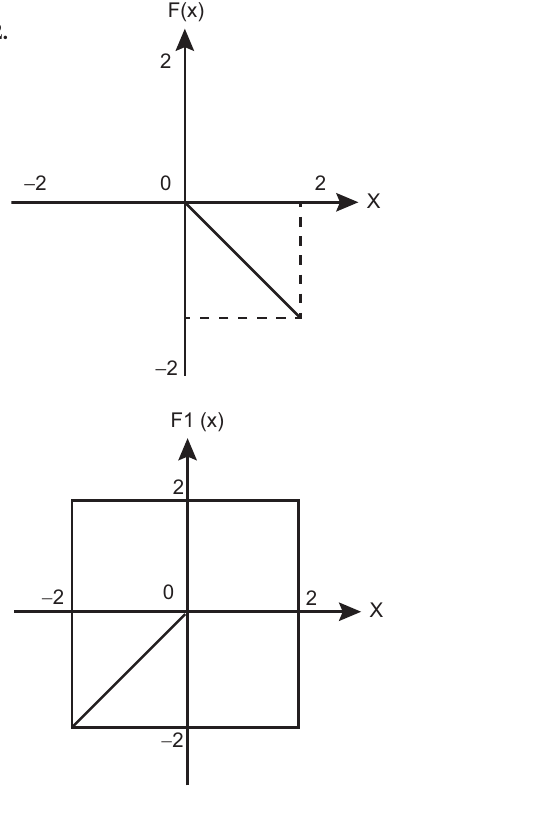
- (1) F1(x) = −F(x)
- (2) F1(x) = F(−x)
- (3) F1(x) = −F(−x)
- (4) if none of the above is true
Show solution
Directions (same as previous): a pair of graphs F(x) and F1(x) composed of straight-line segments in the domain x ∈ (−2, 2). Choose the answer as (1) if F1(x) = −F(x); (2) if F1(x) = F(−x); (3) if F1(x) = −F(−x); (4) if none of the above is true.
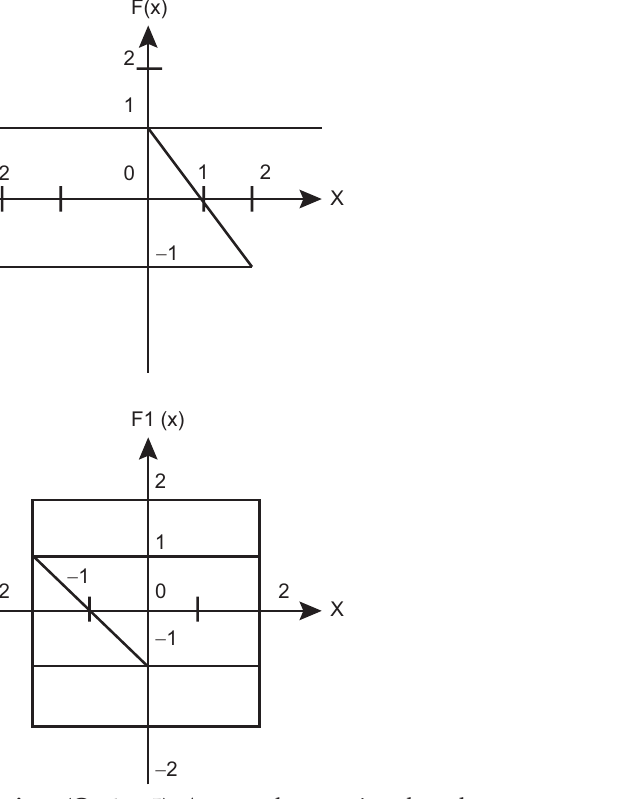
- (1) F1(x) = −F(x)
- (2) F1(x) = F(−x)
- (3) F1(x) = −F(−x)
- (4) if none of the above is true
Show solution
Directions: Let x and y be real numbers and let f(x, y) = |x + y|, F(f(x, y)) = −f(x, y) and G(f(x, y)) = −F(f(x, y)). Which of the following expressions yields x² as its result?
- (1) F(f(x, −x)) · G(f(x, −x))
- (2) F(f(x, x)) · G(f(x, x)) · 4
- (3) −F(f(x, x)) · G(f(x, x)) ÷ log₂ 16
- (4) f(x, x) · f(x, x)
Show solution
Directions: Given below are three graphs made up of straight line segments shown as thick lines. In each case choose the answer as (1) if f(x) = 3 f(−x); (2) if f(x) = −f(−x); (3) if f(x) = f(−x); (4) if 3f(x) = 6 f(−x), for x ≥ 0.
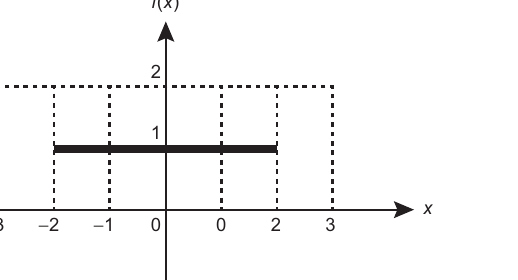
- (1) if f(x) = 3 f(−x)
- (2) if f(x) = −f(−x)
- (3) if f(x) = f(−x)
- (4) if 3f(x) = 6 f(−x), for x ≥ 0
Show solution
Directions (same as previous): choose the answer as (1) if f(x) = 3 f(−x); (2) if f(x) = −f(−x); (3) if f(x) = f(−x); (4) if 3f(x) = 6 f(−x), for x ≥ 0.
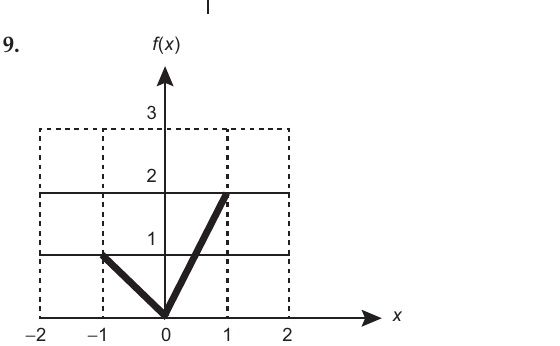
- (1) if f(x) = 3 f(−x)
- (2) if f(x) = −f(−x)
- (3) if f(x) = f(−x)
- (4) if 3f(x) = 6 f(−x), for x ≥ 0
Show solution
Directions (same as previous): choose the answer as (1) if f(x) = 3 f(−x); (2) if f(x) = −f(−x); (3) if f(x) = f(−x); (4) if 3f(x) = 6 f(−x), for x ≥ 0.
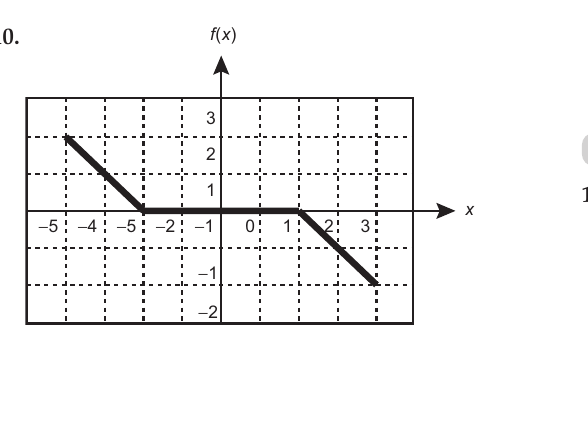
- (1) if f(x) = 3 f(−x)
- (2) if f(x) = −f(−x)
- (3) if f(x) = f(−x)
- (4) if 3f(x) = 6 f(−x), for x ≥ 0
Show solution
Directions: For real numbers x and y, f(x, y) = Positive square root of (x + y), if (x + y)0.5 is real, and (x + y)² otherwise; g(x, y) = (x + y)², if (x + y)0.5 is real, and −(x + y) otherwise. Under which of the following conditions is f(x, y) necessarily greater than g(x, y)?
- (1) Both x and y are less than −1
- (2) Both x and y are positive
- (3) Both x and y are negative
- (4) y > x
Show solution
Directions: For a real number x, let f(x) = 1/(1 + x), if x is non-negative, = 1 + x if x is negative; fⁿ(x) = f(fⁿ⁻¹(x)), n = 2, 3, … What is the value of the product f(2) f²(2) f³(2) f⁴(2) f⁵(2)?
- (1) 1/3
- (2) 3
- (3) 1/18
- (4) None of these
Show solution
With the same f as above, r is an integer ≥ 2. Then what is the value of fr−1(−r) + fr(−r) + fr+1(−r)?
- (1) −1
- (2) 0
- (3) 1
- (4) None of these
Show solution
The area bounded by the three curves |x + y| = 1, |x| = 1, and |y| = 1, is equal to
- (1) 4
- (2) 3
- (3) 2
- (4) 1
Show solution
The set of all positive integers is the union of two disjoint subsets: {f(1), f(2), …, f(n), …} and {g(1), g(2), …, g(n), …}, where f(1) < f(2) < … < f(n) …, and g(1) < g(2) < … < g(n) …, and g(n) = f(f(n)) + 1 for all n ≥ 1. What is the value of g(1)?
- (1) 0
- (2) 2
- (3) 1
- (4) Cannot be determined
Show solution
For all non-negative integers x and y, f(x, y) is defined as below: f(0, y) = y + 1, f(x + 1, 0) = f(x, 1), f(x + 1, y + 1) = f(x, f(x + 1, y)). Then what is the value of f(1, 2)?
- (1) 2
- (2) 4
- (3) 3
- (4) Cannot be determined
Show solution
For all real X, [X] represents the greatest integer. If L(X, Y) = [X] + [Y] + [X+Y] and G(X, Y) = [2X] + [2Y]. Then the ordered pair (X, Y) cannot be determined if
- (1) L(X, Y) > G(X, Y)
- (2) L(X, Y) = G(X, Y)
- (3) L(X, Y) < G(X, Y)
- (4) None of these
Show solution
The number of non-negative real roots of 2ˣ − x − 1 = 0 equals
- (1) 0
- (2) 1
- (3) 2
- (4) 3
Show solution
When the curves, y = log₁₀ x and y = x⁻¹ are drawn in the x − y plane, how many times do they intersect for values x ≥ 1?
- (1) Never
- (2) Once
- (3) Twice
- (4) More than twice
Show solution
Consider the following two curves in the x-y plane: y = x³ + x² + 5, y = x² + x + 5. Which of the following statements is true for −2 ≤ x ≤ 2?
- (1) The two curves intersect once.
- (2) The two curves intersect twice.
- (3) The two curves do not intersect.
- (4) The two curves intersect thrice.
Show solution
Directions: f₁(x) = x for 0 ≤ x ≤ 1, = 1 for x ≥ 1, = 0 otherwise; f₂(x) = f₁(−x) for all x; f₃(x) = −f₂(x) for all x; f₄(x) = f₃(−x) for all x. How many of the following products are necessarily zero for every x: f₁(x)f₂(x), f₂(x)f₃(x), f₂(x)f₄(x)?
- (1) 0
- (2) 1
- (3) 2
- (4) 3
Show solution
With f₁, …, f₄ as above, which of the following is necessarily true?
- (1) f₄(x) = f₁(x) for all x
- (2) f₁(x) = −f₃(−x) for all x
- (3) f₂(−x) = f₄(x) for all x
- (4) f₁(x) + f₃(x) = 0 for all x
Show solution
Let g(x) be a function such that g(x + 1) + g(x − 1) = g(x) for every real x. Then for what value of p is the relation g(x + p) = g(x) necessarily true for every real x?
- (1) 5
- (2) 3
- (3) 2
- (4) 6
Show solution
The graph of y − x against y + x is as shown below. (All graphs in this question are drawn to scale and the same scale has been used on each axis). Then, which of the options given shows the graph of y against x.
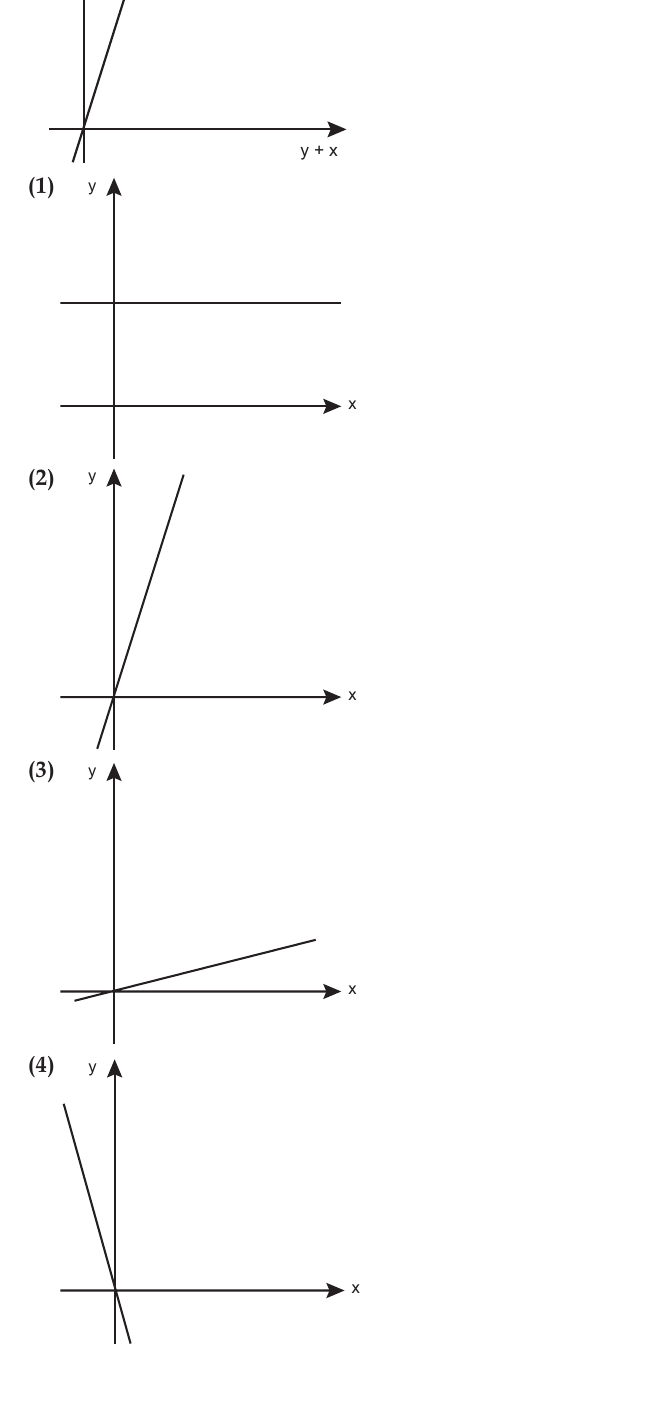
- (1) (graph as shown above)
- (2) (graph as shown above)
- (3) (graph as shown above)
- (4) (graph as shown above)
Show solution
Let f(x) be a function satisfying f(x) f(y) = f(xy) for all real x, y. If f(2) = 4, then what is the value of f(1/2)?
- (1) 0
- (2) 1/4
- (3) 1/2
- (4) 1
Show solution
If f₁(x) = x² + 11x + n and f₂(x) = x, then the largest positive integer n for which the equation f₁(x) = f₂(x) has two distinct real roots is
Show solution
Let f(x) = x² and g(x) = 2ˣ, for all real x. Then the value of f[f(g(x)) + g(f(x))] at x = 1 is:
- (1) 16
- (2) 18
- (3) 36
- (4) 40
Show solution
If f(ab) = f(a)f(b) for all positive integers a and b, then the largest possible value of f(1) is
Show solution
If f(x) = (5x + 2)/(3x − 5) and g(x) = x² − 2x − 1, then the value of g(f(f(3))) is:
- (1) 2
- (2) 1/3
- (3) 6
- (4) 2/3
Show solution
If f(x+2) = f(x) + f(x+1) for all positive integers x, and f(11) = 91, f(15) = 617, then f(10) equals
Show solution
Consider a function f satisfying f(x + y) = f(x) f(y) where x, y are positive integers, and f(1) = 2. If f(a + 1) + f(a + 2) + … + f(a + n) = 16 (2ⁿ − 1) then a is equal to
Show solution
For any positive integer n, let f(n) = n(n + 1) if n is even, and f(n) = n + 3 if n is odd. If m is a positive integer such that 8f(m + 1) − f(m) = 2, then m equals
Show solution
Let f be a function such that f(mn) = f(m) f(n) for every positive integers m and n. If f(1), f(2) and f(3) are positive integers, f(1) < f(2), and f(24) = 54, then f(18) equals
Show solution
The number of the real roots of the equation 2 cos (x(x + 1)) = 2ˣ + 2⁻ˣ is:
- (1) 2
- (2) 1
- (3) Infinite
- (4) 0
Show solution
If f(5 + x) = f(5 − x) for every real x, and f(x) = 0 has four distinct real roots, then the sum of these roots is:
- (1) 40
- (2) 10
- (3) 20
- (4) 0
Show solution
If f(x + y) = f(x) f(y) and f(5) = 4, then f(10) − f(− 10) is equal to
- (1) 15.9375
- (2) 0
- (3) 3
- (4) 14.0625
Show solution
f(x) = (x² + 2x − 15)/(x² − 7x − 18) is negative if and only if
- (1) x < −5 or −2 < x < 3
- (2) −5 < x < −2 or 3 < x < 9
- (3) −2 < x < 3 or x > 9
- (4) x < − 5 or 3 < x < 9
Show solution
For all real values of x, the range of the function f(x) = (x² + 2x + 4)/(2x² + 4x + 9) is
- (1) [3/7, 8/9)
- (2) (3/7, 1/2)
- (3) [3/7, 1/2)
- (4) [4/9, 8/9]
Show solution
If f(x) = x² − 7x and g(x) = x + 3, then the minimum value of the function f(g(x)) − 3x is:
- (1) −15
- (2) −20
- (3) −16
- (4) −12
Show solution
Let a, b, c be non-zero real numbers such that b² < 4ac, and f(x) = ax² + bx + c. If the set S consists of all integers m such that f(m) < 0, then the set S must necessarily be:
- (1) either the empty set or the set of all integers
- (2) the set of all integers
- (3) the set of all positive integers
- (4) the empty set
Show solution
Suppose for all integers x, there are two functions f and g such that f(x) + f(x − 1) − 1 = 0 and g(x) = x². If f(x² − x) = 5, then the value of the sum f(g(5)) + g(f(5)) is:
Show solution
Let r be a real number and f(x) = 2x − r if x ≥ r, and = r if x < r. Then, the equation f(x) = f(f(x)) holds for all real:
- (1) x ≤ r
- (2) x > r
- (3) x ≥ r
- (4) x ≠ r
Show solution
Let f(x) be a quadratic polynomial in x such that f(x) ≥ 0 for all real numbers x. If f(2) = 0 and f(4) = 6, then f(−2) is equal to:
- (1) 36
- (2) 12
- (3) 24
- (4) 6
Show solution
Suppose f(x, y) is a real-valued function such that f(3x + 2y, 2x − 5y) = 19x, for all real numbers x and y. The value of x for which f(x, 2x) = 27, is
Show solution
CAT 2024 & 2025, recent
A function f maps the set of natural numbers to whole numbers, such that f(xy) = f(x)f(y) + f(x) + f(y) for all x, y and f(p) = 1 for every prime number p. Then, the value of f(160000) is
- (A) 8191
- (B) 2047
- (C) 4095
- (D) 1023
Show solution
Let f(x) = x/(2x − 1) and g(x) = x/(x − 1). Then, the domain of the function h(x) = f(g(x)) + g(f(x)) is all real numbers except
- (A) −1, 1/2, and 1
- (B) 1/2, 1, and 3/2
- (C) −1/2, 1/2, and 1
- (D) 1/2 and 1
Show solution
Logarithms · 18 CAT PYQs
Logarithms
log₆ 216√6 is:
- (1) 3
- (2) 3/2
- (3) 7/2
- (4) None of these
Show solution
If log₇ log₅ (√(x + 5) + √x) = 0, find the value of x.
- (1) 1
- (2) 0
- (3) 2
- (4) None of these
Show solution
If log₂ [log₇ (x² − x + 37)] = 1, then what could be the value of 'x'?
- (1) 3
- (2) 5
- (3) 4
- (4) None of these
Show solution
If log₃ 2, log₃ (2ˣ − 5), log₃ (2ˣ − 7/2) are in arithmetic progression, Then the value of x is equal to ___.
- (1) 5
- (2) 4
- (3) 2
- (4) 3
Show solution
If log₁₀ x − log₁₀ √x = 2 log_x 10, then a possible value of x is given by
- (1) 10
- (2) 1/100
- (3) 1/1000
- (4) None of these
Show solution
Let u = (log₂ x)² − 6 log₂ x + 12 where x is a real number. Then the equation xᵘ = 256, has
- (1) no solution for x
- (2) exactly one solution for x
- (3) exactly two distinct solutions for x
- (4) exactly three distinct solutions for x
Show solution
If x ≥ y and y > 1, then the value of the expression log_x(x/y) + log_y(y/x) can never be
- (1) −1
- (2) −0.5
- (3) 0
- (4) 1
Show solution
Suppose log₃ x = log₁₂ y = a, where x, y are positive numbers. If G is the geometric mean of x and y, and log₆ G is equal to
- (1) √a
- (2) 2a
- (3) a/2
- (4) a
Show solution
If x is a real number such that log₃ 5 = log₅ (2 + x), then which of the following is true?
- (1) 0 < x < 3
- (2) 23 < x < 30
- (3) x > 30
- (4) 3 < x < 23
Show solution
If log (2ᵃ × 3ᵇ × 5ᶜ) is the arithmetic mean of log (2² × 3³ × 5), log (2⁶ × 3 × 5⁷), and log (2 × 3² × 5⁴), then a equals:
Show solution
If log₂ (5 + log₃ a) = 3 and log₅ (4a + 12 + log₂ b) = 3, then a + b is equal to:
- (1) 59
- (2) 40
- (3) 32
- (4) 67
Show solution
If x and y be positive real numbers such that log₅ (x + y) + log₅ (x − y) = 3, and log₂ y − log₂ x = 1 − log₂ 3. Then xy equals
- (1) 150
- (2) 25
- (3) 100
- (4) 250
Show solution
Let A be a real number. Then the roots of the equation x² − 4x − log₂ A = 0 are real and distinct if and only if
- (1) A > 1/16
- (2) A < 1/16
- (3) A < 1/8
- (4) A > 1/8
Show solution
If 5 − log₁₀ √(1 + x) + 4 log₁₀ √(1 − x) = log₁₀ (1/√(1 − x²)), then 100x equals
Show solution
If log₂ [3 + log₃ {4 + log₄ (x − 1)}] − 2 = 0, then 4x equals
Show solution
The number of distinct integer values of n satisfying (4 − log₂ n)/(3 − log₄ n) < 0 is:
Show solution
If x and y are positive real numbers such that log_x (x² + 12) = 4 and 3 log_y x = 1, then x + y equals
- (1) 10
- (2) 68
- (3) 20
- (4) 11
Show solution
For some positive real number x, if log_√3 (x) + (log_x 25)/(log_x 0.008) = 16/3, then the value of log₃ (3x²) is
Show solution
Surds & Indices · 20 CAT PYQs
Surds & Indices
Which among 2^(1/2), 3^(1/3), 4^(1/4), 6^(1/6) and 12^(1/12) is the largest?
- (1) 2^(1/2)
- (2) 3^(1/3)
- (3) 4^(1/4)
- (4) 6^(1/6)
Show solution
If x + 1 = x² and x > 0, then 2x⁴ is
- (1) 6 + 4√5
- (2) 3 + 3√5
- (3) 5 + 3√5
- (4) 7 + 3√5
Show solution
If 9^(2x−1) − 81^(x−1) = 1944, then x is:
- (1) 3
- (2) 9/4
- (3) 4/9
- (4) 1/3
Show solution
If 9^(x−½) − 2^(2x−2) = 4^x − 3^(2x−3), then x is
- (1) 3/2
- (2) 2/5
- (3) 3/4
- (4) 4/9
Show solution
The real root of the equation 2⁶ˣ + 2³ˣ⁺² − 21 = 0 is:
- (1) log₂9
- (2) (log₂3)/3
- (3) log₂27
- (4) (log₂7)/3
Show solution
If 5ˣ − 3ʸ = 13438 and 5^(x−1) + 3^(y+1) = 9686, then x + y equals:
Show solution
How many distinct positive integer-valued solutions exist to the equation (x² − 7x + 11)^(x² − 13x + 42) = 1?
- (1) 2
- (2) 4
- (3) 8
- (4) 6
Show solution
The number of integers that satisfy the equality (x² − 5x + 7)^(x+1) = 1 is:
- (1) 2
- (2) 3
- (3) 4
- (4) 5
Show solution
Suppose one of the roots of the equation ax² − bx + c = 0 is 2 + √3, where a, b and c are rational numbers and a ≠ 0. If b = c³, then |a| equals
- (1) 3
- (2) 1
- (3) 4
- (4) 2
Show solution
For all possible integers n satisfying 2.25 ≤ 2 + 2^(n+2) ≤ 202, the number of integer values of 3 + 3^(n+1) is
Show solution
If n is a positive integer such that (⁷√10)(⁷√10)²…(⁷√10)ⁿ > 999, then the smallest value of n is
Show solution
The number of integer solutions of the equation (x² − 10)^(x² − 3x − 10) = 1 is:
Show solution
Let n be any natural number such that 5^(n−1) < 3^(n+1). Then, the least integer value of m that satisfies 3^(n+1) < 2^(n+m) for each such n, is
Show solution
The sum of all possible values of x satisfying the equation 2^(4x²) − 2^(2x²+x+16) + 2^(2x+30) = 0, is
- (1) 3
- (2) 5/2
- (3) 3/2
- (4) 1/2
Show solution
Let a, b, m and n be natural numbers such that a > 1 and b > 1. If aᵐbⁿ = 144¹⁴⁵, then the largest possible value of n − m is
- (1) 579
- (2) 580
- (3) 289
- (4) 290
Show solution
Let n and m be two positive integers such that there are exactly 41 integers greater than 8ᵐ and less than 8ⁿ, which can be expressed as powers of 2. Then, the smallest possible value of n + m is
- (1) 44
- (2) 14
- (3) 16
- (4) 42
Show solution
If x is a positive real number such that x⁸ + (1/x)⁸ = 47, then the value of x⁹ + (1/x)⁹ is
- (1) 34√5
- (2) 40√5
- (3) 30√5
- (4) 36√5
Show solution
CAT 2024 & 2025, recent
If (a + b√n) is the positive square root of (29 − 12√5), where a and b are integers, and n is a natural number, then the maximum possible value of (a + b + n) is
- (A) 18
- (B) 22
- (C) 4
- (D) 6
Show solution
If (x + 6√2)^(1/2) − (x − 6√2)^(1/2) = 2√2, then x equals
Show solution
If (a + b√3)² = 52 + 30√3, where a and b are natural numbers, then a + b equals
- (A) 7
- (B) 8
- (C) 9
- (D) 10
Show solution
Progressions & Series · 49 CAT PYQs
Progressions & Series
The 288th term of the series a, b, b, c, c, c, d, d, d, d, e, e, e, e, e, f, f, f, f, f, f… is
- (1) u
- (2) v
- (3) w
- (4) x
Show solution
There are 8436 steel balls, each with a radius of 1 centimetre, stacked in a pile, with 1 ball on top, 3 balls in the second layer, 6 in the third layer, 10 in the fourth, and so on. The number of horizontal layers in the pile is
- (1) 34
- (2) 38
- (3) 36
- (4) 32
Show solution
The sum of 3rd and 15th elements of an arithmetic progression is equal to the sum of the 6th, 11th and 13th elements of the same progression. Then which element of the series should necessarily be equal to zero?
- (1) 1st
- (2) 9th
- (3) 12th
- (4) None of these
Show solution
Let T be the set of integers {3, 11, 19, 27, … 451, 459, 467} and S be a subset of T such that the sum of no two elements of S is 470. The maximum possible number of elements in S is
- (1) 32
- (2) 28
- (3) 29
- (4) 30
Show solution
Let S = 2x + 5x² + 9x³ + 14x⁴ + 20x⁵ ……infinity. The coefficient of nth term is n(n+3)/2. The sum S is:
- (1) x(2−x)/(1−x)³
- (2) (2−x)/(1−x)³
- (3) x(2−x)/(1−x)²
- (4) None of these
Show solution
If the sum of the first 11 terms of an arithmetic progression equals that of the first 19 terms, then what is the sum of the first 30 terms?
- (1) 0
- (2) −1
- (3) 1
- (4) Not unique
Show solution
If a₁ = 1 and aₙ₊₁ − 3aₙ + 2 = 4n for every positive integer n, then a₁₀₀ equals
- (1) 3⁹⁹ − 200
- (2) 3⁹⁹ + 200
- (3) 3¹⁰⁰ − 200
- (4) 3¹⁰⁰ + 200
Show solution
The infinite sum 1 + 4/7 + 9/7² + 16/7³ + 25/7⁴ + …. equals:
- (1) 27/14
- (2) 21/13
- (3) 49/27
- (4) 256/147
Show solution
Let S₁ be a square of side a. Another square S₂ is formed by joining the mid-points of the sides of S₁. The same process is applied to S₂ to form yet another square S₃, and so on. If A₁, A₂, A₃, …… be the areas and P₁, P₂, P₃, …… be the perimeters of S₁, S₂, S₃, ……, respectively, then the ratio (P₁ + P₂ + P₃ + ……)/(A₁ + A₂ + A₃ + ……) equals:
- (1) 2(1+√2)/a
- (2) 2(2−√2)/a
- (3) 2(2+√2)/a
- (4) 2(1+2√2)/a
Show solution
A function f satisfies f(1) = 3600 and f(1) + f(2) + … + f(n) = n²·f(n) for all n > 1. What is f(9)?
- (1) 80
- (2) 240
- (3) 200
- (4) 100
Show solution
The number of common terms in the two sequences 17, 21, 25, … , 417 and 16, 21, 26, … , 466 is:
- (1) 78
- (2) 19
- (3) 20
- (4) 77
Show solution
Consider the set S = {1, 2, 3, …., 1000}. How many arithmetic progressions can be formed from the elements of S that start with 1 and with 1000 and have at least 3 elements?
- (1) 3
- (2) 4
- (3) 6
- (4) 7
Show solution
Find the sum √(1 + 1/1² + 1/2²) + √(1 + 1/2² + 1/3²) + … + √(1 + 1/2007² + 1/2008²).
- (1) 2008 − 1/2008
- (2) 2007 − 1/2007
- (3) 2007 − 1/2008
- (4) 2008 − 1/2007
Show solution
If the square of the 7th term of an arithmetic progression with positive common difference equals the product of the 3rd and 17th terms, then the ratio of the first term to the common difference is:
- (1) 2 : 3
- (2) 3 : 2
- (3) 3 : 4
- (4) 4 : 3
Show solution
Let a₁, a₂, …, aₙ, be an arithmetic progression with a₁ = 3 and a₂ = 7. If a₁ + a₂ + … + aₙ = 1830, then what is the smallest positive integer m such that m(a₁ + a₂ + … + aₘ) > 1830?
- (1) 8
- (2) 9
- (3) 10
- (4) 11
Show solution
Let a₁, a₂, a₃, a₄, a₅ be a sequence of five consecutive odd numbers. Consider a new sequence of five consecutive even numbers ending with 2a₃. If the sum of the numbers in the new sequence is 450, then a₅ is
Show solution
An infinite geometric progression a₁, a₂, a₃, … has the property that aₙ = 3(aₙ₊₁ + aₙ₊₂ + …) for every n ≥ 1. If the sum a₁ + a₂ + a₃ + … = 32, then a₅ is
- (1) 1/32
- (2) 2/32
- (3) 3/32
- (4) 4/32
Show solution
If a₁ = 1/(2×5), a₂ = 1/(5×8), a₃ = 1/(8×11), …, then a₁ + a₂ + … + a₁₀₀ is
- (1) 25/151
- (2) 1/2
- (3) 1/4
- (4) 111/55
Show solution
Consider a sequence where the nth term, tₙ = n/(n+2), n = 1, 2, … . The value of t₃ × t₄ × t₅ × … × t₅₃ equals:
- (1) 2/495
- (2) 2/477
- (3) 12/55
- (4) 1/1485
Show solution
If a₁ + a₂ + a₃ + … + aₙ = 3(2ⁿ⁺¹ − 2), for every n ≥ 1, then a₁₁ equals
Show solution
Let a₁, a₂, … be integers such that a₁ − a₂ + a₃ − a₄ + … + (−1)ⁿ⁻¹ aₙ = n, for all n ≥ 1. Then a₅₁ + a₅₂ + … + a₁₀₂₃ equals
- (1) 0
- (2) 1
- (3) 10
- (4) −1
Show solution
Given an equilateral triangle T₁ with side 24 cm, a second triangle T₂ is formed by joining the midpoints of the sides of T₁. Then a third triangle T₃ is formed by joining the midpoints of the sides of T₂. If this process of forming triangles is continued, the sum of the areas, in sq cm, of infinitely many such triangles T₁, T₂, T₃, … will be
- (1) 188√3
- (2) 248√3
- (3) 164√3
- (4) 192√3
Show solution
Let x, y, z be three positive real numbers in a geometric progression such that x < y < z. If 5x, 16y, and 12z are in arithmetic progression then the common ratio of the geometric progression is
- (1) 3/6
- (2) 1/6
- (3) 5/2
- (4) 3/2
Show solution
Let a₁, a₂…a₅₂ be positive integers such that a₁ < a₂ < … < a₅₂. Suppose, their arithmetic mean is one less than arithmetic mean of a₂, a₃, …. a₅₂. If a₅₂ = 100, then the largest possible value of a₁ is
- (1) 48
- (2) 20
- (3) 23
- (4) 45
Show solution
The value of the sum 7 × 11 + 11 × 15 + 15 × 19 + … + 95 × 99 is
Show solution
The arithmetic mean of x, y and z is 80, and that of x, y, z, u and v is 75, where u = n(n+1)/2 and v = (y+z)/2. If x ≥ z, then the minimum possible value of x is
Show solution
If (2n + 1) + (2n + 3) + (2n + 5) + … + (2n + 47) = 5280, then what is the value of 1 + 2 + 3 + …. + n?
Show solution
Let t₁, t₂,… be real with t₁ + t₂ + … + tₙ = 2n² + 9n + 13 for every integer n ≥ 2. If t_k = 103, then k equals
Show solution
The number of common terms in the two sequences: 15, 19, 23, 27, …., 415 and 14, 19, 24, 29, …, 464 is:
- (1) 21
- (2) 20
- (3) 18
- (4) 19
Show solution
If the population of a town is p in the beginning of any year then it becomes 3 + 2p in the beginning of the next year. If the population in the beginning of 2019 is 1000, then the population in the beginning of 2034 will be
- (1) (1003)¹⁵ + 6
- (2) (997)¹⁵ − 3
- (3) (997)2¹⁴ + 3
- (4) (1003)2¹⁵ − 3
Show solution
If x₁ = −1 and xₘ = xₘ₊₁ + (m + 1) for every positive integer m, then x₁₀₀ equals
- (1) −5151
- (2) −5150
- (3) −5051
- (4) −5050
Show solution
In a group of 10 students, the mean of the lowest 9 scores is 42 while the mean of the highest 9 scores is 47. For the entire group of 10 students, the maximum possible mean exceeds the minimum possible mean by:
- (1) 3
- (2) 6
- (3) 5
- (4) 4
Show solution
Let the mth and nth terms of a geometric progression be 3/4 and 12, respectively, where m < n. If the common ratio of the progression is an integer r, then the smallest possible value of r + n − m is:
- (1) 6
- (2) −4
- (3) −2
- (4) 2
Show solution
If x₀ = 1, x₁ = 2, and xₙ₊₂ = (1 + xₙ₊₁)/xₙ, n = 0, 1, 2, 3, …, then x₂₀₂₁ is equal to
- (1) 1
- (2) 2
- (3) 3
- (4) 4
Show solution
Three positive integers x, y and z are in arithmetic progression. If y − x > 2 and xyz = 5(x + y + z), then z − x equals
- (1) 8
- (2) 12
- (3) 10
- (4) 14
Show solution
For a sequence of real numbers x₁, x₂, …, xₙ, if x₁ − x₂ + x₃ − … + (−1)ⁿ⁺¹ xₙ = n² + 2n for all natural numbers n, then the sum x₄₉ + x₅₀ equals
- (1) −2
- (2) 2
- (3) −200
- (4) 200
Show solution
Consider a sequence of real numbers x₁, x₂, x₃, … such that xₙ₊₁ = xₙ + n − 1 for all n ≥ 1. If x₁ = −1, then x₁₀₀ is equal to
- (1) 4949
- (2) 4850
- (3) 4849
- (4) 4950
Show solution
For any natural number n, suppose the sum of the first n terms of an arithmetic progression is (n + 2n²). If the nth term of the progression is divisible by 9, then the smallest possible value of n is:
- (1) 8
- (2) 7
- (3) 4
- (4) 9
Show solution
The average of a non-decreasing sequence of N numbers a₁, a₂, ……, aN is 300. If a₁ is replaced by 6a₁, the new average becomes 400. Then, the number of possible values of a₁ is:
Show solution
On day one, there are 100 particles in a laboratory experiment. On day n, where n ≥ 2, one out of every n particles produces another particle. If the total number of particles in the laboratory experiment increases to 1000 on day m, then m equals:
- (1) 19
- (2) 17
- (3) 16
- (4) 18
Show solution
Consider the arithmetic progression 3, 7, 11, … and let Aₙ denote the sum of the first n terms of this progression. Then the value of (1/25)·Σ(n=1 to 25) Aₙ is:
- (1) 442
- (2) 404
- (3) 455
- (4) 415
Show solution
The arithmetic mean of all the distinct numbers that can be obtained by rearranging the digits in 1421, including itself, is
- (1) 2442
- (2) 3333
- (3) 2592
- (4) 2222
Show solution
A lab experiment measures the number of organisms at 8 am every day. Starting with 2 organisms on the first day, the number of organisms on any day is equal to 3 more than twice the number on the previous day. If the number of organisms on the nth day exceeds one million, then the lowest possible value of n is
Show solution
The arithmetic mean of scores of 25 students in an examination is 50. Five of these students top the examination with the same score. If the scores of the other students are distinct integers with the lowest being 30, then the maximum possible score of the toppers is
Show solution
Let both the series a₁, a₂, a₃, … and b₁, b₂, b₃, … be in arithmetic progression such that the common differences of both the series are prime numbers. If a₅ = b₉, a₁₉ = b₁₉ and b₂ = 0, then a₁₁ equals
- (1) 86
- (2) 84
- (3) 79
- (4) 83
Show solution
Let aₙ and bₙ be two sequences such that aₙ = 13 + 6(n−1) and bₙ = 15 + 7(n−1) for all natural numbers n. Then, the largest three-digit integer that is common to both these sequences, is
Show solution
Let aₙ = 46 + 8n and bₙ = 98 + 4n be two sequences for natural numbers n ≤ 100. Then, the sum of all terms common to both the sequences is
- (1) 14602
- (2) 14798
- (3) 15000
- (4) 14900
Show solution
CAT 2024 & 2025, recent
Suppose x₁, x₂, x₃, …, x₁₀₀ are in arithmetic progression such that x₅ = −4 and 2x₆ + 2x₉ = x₁₁ + x₁₃. Then, x₁₀₀ equals
- (A) −194
- (B) −196
- (C) 204
- (D) 206
Show solution
Let aₙ be the nᵗʰ term of a decreasing infinite geometric progression. If a₁ + a₂ + a₃ = 52 and a₁a₂ + a₂a₃ + a₃a₁ = 624, then the sum of this geometric progression is
- (A) 57
- (B) 54
- (C) 60
- (D) 63
Show solution
Maxima-Minima · 17 CAT PYQs
Maxima-Minima
Let x, y be two positive numbers such that x + y = 1. Then, the minimum value of (x + 1/x)² + (y + 1/y)² is
- (1) 12
- (2) 20
- (3) 12.5
- (4) 13.3
Show solution
For three integers x, y and z, x + y + z = 5, and xy + yz + xz = 3. What is the largest value which x can take?
- (1) 3√13
- (2) √19
- (3) 13/3
- (4) √15
Show solution
If three positive real numbers x, y, z satisfy y − x = z − y and xyz = 4, then what is the minimum possible value of y?
- (1) 2^(1/3)
- (2) 2^(2/3)
- (3) 2^(1/4)
- (4) 2^(3/4)
Show solution
Let a, b, c, d be four integers such that a + b + c + d = 4m + 1 where m is a positive integer. Which one of the following is necessarily true?
- (1) The minimum possible value of a² + b² + c² + d² is 4m² − 2m + 1
- (2) The minimum possible value of a² + b² + c² + d² is 4m² + 2m + 1
- (3) The maximum possible value of a² + b² + c² + d² is 4m² − 2m + 1
- (4) The maximum possible value of a² + b² + c² + d² is 4m² + 2m + 1
Show solution
Let f(x) = ax² − b |x|, where a and b are constants. Then at x = 0, f(x) is
- (1) maximized whenever a > 0, b > 0
- (2) maximized whenever a > 0, b < 0
- (3) minimized whenever a > 0, b > 0
- (4) minimized whenever a > 0, b < 0
Show solution
Let f(x) = max (2x + 1, 3 − 4x), where x is any real number. Then the minimum possible value of f(x) is:
- (1) 1/3
- (2) 1/2
- (3) 2/3
- (4) 5/3
Show solution
A quadratic function f(x) attains a maximum of 3 at x = 1. The value of the function at x = 0 is 1. What is the value of f(x) at x = 10?
- (1) −119
- (2) −159
- (3) −110
- (4) −180
Show solution
If a, b, c, and d are integers such that a + b + c + d = 30 then the minimum possible value of (a − b)² + (a − c)² + (a − d)² is
Show solution
Let f(x) = min (2x², 52 − 5x) where x is any positive real number. Then the maximum possible value of f(x) is
Show solution
Let f(x) = max(5x, 52 − 2x²), where x is any positive real number. Then the minimum possible value of f(x) is
Show solution
If x and y are positive real numbers satisfying x + y = 102, then the minimum possible value of 2601(1 + 1/x)(1 + 1/y) is:
Show solution
For real x, the maximum possible value of x/√(1 + x⁴) is:
- (1) 1/√3
- (2) 1/√2
- (3) 1/2
- (4) 1
Show solution
If f(x) = x² − 7x and g(x) = x + 3, then the minimum value of f(g(x)) − 3x is
- (1) − 15
- (2) − 20
- (3) − 16
- (4) − 12
Show solution
Let 0 ≤ a ≤ x ≤ 100 and f(x) = |x − a| + |x − 100| + |x − a − 50|. Then, the maximum value of f(x) becomes 100 when a is equal to:
- (1) 0
- (2) 25
- (3) 100
- (4) 50
Show solution
The minimum possible value of (x² − 6x + 10)/(3 − x), for x < 3, is:
- (1) −2
- (2) 2
- (3) 1/2
- (4) −1/2
Show solution
Let k be the largest integer such that the equation (x − 1)² + 2kx + 11 = 0 has no real roots. If y is a positive real number, then the least possible value of k/(4y) + 9y is
Show solution
CAT 2024 & 2025, recent
If m and n are integers such that (m + 2n)(2m + n) = 27, then the maximum possible value of 2m − 3n is: