LR · Games, Networks & Misc , tournaments, routes & math-reasoning
Tournaments/games, networks/routes, congestion games, and math-reasoning puzzles that don't fit the other families. List every valid path, sum edge costs and tolls, and translate clues into equations.
Approach Sheet, Games, Networks & Misc
How to handle tournaments, route/network sets and math-reasoning puzzles.
- Clues hide arithmetic, percentages, ratios, averages, products of ages, costs.
- Assign variables, write one equation per clue, solve simultaneously.
- Use number properties & factor lists (e.g. age-product puzzles).
- Plug answer options back in when direct algebra is messy.
- Knockout / elimination: n teams ⇒ n − 1 matches total (byes included).
- Round-robin (all-play-all): ⁿC₂ matches for n teams.
- Seeding: in round 1, seed k plays seed (N+1−k); favourites meet late. An upset = lower seed beats higher.
- "M did not beat N" ≠ "N won", a draw/tie may be possible. Read win/loss logic carefully.
- Nodes (junctions) + directed edges with costs/times. List every valid path S→T.
- Total cost of a route = sum of edge costs + tolls/penalties at nodes.
- For "make all routes equal-cost", set path-cost expressions equal and solve for tolls.
- Congestion games: travel time rises per extra car, equilibrium = no car can switch and gain.
Real CAT LR Sets, Games, Networks & Misc
Actual CAT previous-year game, network/route and math-reasoning sets from the book. Difficulty: Easy Moderate Hard. Click any question to reveal the solution.
CAT 2001
SET (Q. 1 to 3), Coloured leaves & budgets (mathematical reasoning). Directions: Answer the questions on the basis of the following information.
1. On her walk through the park, Hansa collected 50 coloured leaves, all either maple or oak. She sorted them by category when she got home, and found the following:
A. The number of red oak leaves with spots is even and positive.
B. The number of red oak leaves without any spot equals the number of red maple leaves without spots.
C. All non-red oak leaves have spots, and there are five times as many of them as there are red spotted oak leaves.
D. There are no spotted maple leaves that are not red.
E. There are exactly 6 red spotted maple leaves.
F. There are exactly 22 maple leaves that are neither spotted nor red.
How many oak leaves did she collect?
- (1) 22
- (2) 17
- (3) 25
- (4) 18
Show solution
2. I have a total of ₹1,000. Item A costs ₹110, item B costs ₹90, item C costs ₹70, item D costs ₹40 and item E costs ₹45. For every item D that I purchase, I must also buy two of item B. For every item A, I must buy one of item C. For every item E, I must also buy two of item D and one of item B. For every item purchased I earn 1000 points and for every rupee not spent I earn a penalty of 1500 points. My objective is to maximise the points I earn. What is the number of items that I must purchase to maximise my points?
- (1) 13
- (2) 14
- (3) 15
- (4) 16
Show solution
3. Four friends Ashok, Bashir, Chirag and Deepak are out for shopping. Ashok has less money than three times the amount that Bashir has. Chirag has more money than Bashir. Deepak has an amount equal to the difference of amounts with Bashir and Chirag. Ashok has three times the money with Deepak. They each have to buy at least one shirt, or one shawl, or one sweater, or one jacket that are priced ₹200, ₹400, ₹600, and ₹1,000 per piece, respectively. Chirag borrows ₹300 from Ashok and buys a jacket. Bashir buys a sweater after borrowing ₹100 from Ashok and is left with no money. Ashok buys three shirts. What is the costliest item that Deepak could buy with his own money?
- (1) A shirt
- (2) A shawl
- (3) A sweater
- (4) A jacket
Show solution
CAT 2003
SET (Q. 4 to 6), Rang Barsey Paint Company. Directions: Answer the questions on the basis of the following information. Rang Barsey Paint Company (RBPC) is in the business of manufacturing paints. RBPC buys RED, YELLOW, WHITE, ORANGE, and PINK paints. ORANGE paint can be also produced by mixing RED and YELLOW paints in equal proportions. Similarly, PINK paint can also be produced by mixing equal amounts of RED and WHITE paints. Among other paints, RBPC sells CREAM paint (formed by mixing WHITE and YELLOW in the ratio 70 : 30), AVOCADO paint (formed by mixing equal amounts of ORANGE and PINK paint) and WASHEDORANGE paint (formed by mixing equal amounts of ORANGE and WHITE paint). The following table provides the price at which RBPC buys paints.
| Colour | ₹/litre |
|---|---|
| RED | 20 |
| YELLOW | 25 |
| WHITE | 15 |
| ORANGE | 22 |
| PINK | 18 |
4. The cheapest way to manufacture AVOCADO paint would cost
- (1) ₹19.50 per litre.
- (2) ₹19.75 per litre.
- (3) ₹20.00 per litre.
- (4) ₹20.25 per litre.
Show solution
5. WASHEDORANGE can be manufactured by mixing
- (1) CREAM and RED in the ratio 14 : 10.
- (2) CREAM and RED in the ratio 3 : 1.
- (3) YELLOW and PINK in the ratio 1 : 1.
- (4) RED, YELLOW, and WHITE in the ratio 1 : 1 : 2.
Show solution
6. Assume that AVOCADO, CREAM, and WASHEDORANGE each sells for the same price. Which of the three is the most profitable to manufacture?
- (1) AVOCADO
- (2) CREAM
- (3) WASHEDORANGE
- (4) Sufficient data is not available
Show solution
SET (Q. 7 and 8), Basketball free throws. Directions: Answer the questions on the basis of the following information. Some children were taking free throws at the basketball court in school during lunch break. Below are some facts about how many baskets these children shot.
(a) Ganesh shot 8 baskets less than Ashish.
(b) Dhanraj and Ramesh together shot 37 baskets.
(c) Jugraj shot 8 baskets more than Dhanraj.
(d) Ashish shot 5 baskets more than Dhanraj.
(e) Ashish and Ganesh together shot 40 baskets.
7. Which of the following statements is true?
- (1) Ramesh shot 18 baskets and Dhanraj shot 19 baskets.
- (2) Ganesh shot 24 baskets and Ashish shot 16 baskets.
- (3) Jugraj shot 19 baskets and Dhanraj shot 27 baskets.
- (4) Dhanraj shot 11 baskets and Ashish shot 16 baskets.
Show solution
8. Which of the following statements is true?
- (1) Dhanraj and Jugraj together shot 46 baskets.
- (2) Ganesh shot 18 baskets and Ramesh shot 21 baskets.
- (3) Dhanraj shot 3 more baskets than Ramesh.
- (4) Ramesh and Jugraj together shot 29 baskets.
Show solution
CAT 2006
SET (Q. 16 to 20), Traffic network & tolls. Directions: Answer the questions on the basis of the following information. A significant amount of traffic flows from point S to point T in the one-way street network shown below.
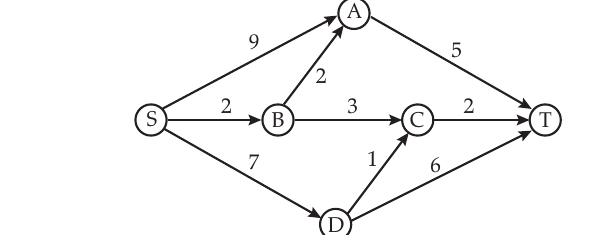
Points A, B, C, and D are junctions in the network, and the arrows mark the direction of traffic flow. The fuel cost in rupees for travelling along a street is indicated by the number adjacent to the arrow representing the street. Motorists travelling from point S to point T would obviously take the route for which the total cost of travelling is the minimum. If two or more routes have the same least travel cost, then motorists are indifferent between them. Hence, the traffic gets evenly distributed among all the least cost routes. The government can control the flow of traffic only by levying appropriate toll at each junction. For example, if a motorist takes the route S-A-T (using junction A alone), then the total cost of travel would be ₹14 (i.e., ₹9 + ₹5) plus the toll charged at junction A.
16. If the government wants to ensure that all motorists travelling from S to T pay the same amount (fuel costs and toll combined) regardless of the route they choose and the street from B to C is under repairs (and hence unusable), then a feasible set of toll charged (in rupees) at junctions A, B, C, and D respectively to achieve this goal is:
- (1) 2, 5, 3, 2
- (2) 0, 5, 3, 1
- (3) 1, 5, 3, 2
- (4) Both (2) and (3) are true.
Show solution
17. If the government wants to ensure that no traffic flows on the street from D to T, while equal amount of traffic flows through junctions A and C, then a feasible set of toll charged (in rupees) at junctions A, B, C, and D respectively to achieve this goal is:
- (1) 1, 5, 3, 3
- (2) 1, 4, 4, 3
- (3) 1, 5, 4, 2
- (4) 0, 5, 2, 2
Show solution
18. If the government wants to ensure that all routes from S to T get the same amount of traffic, then a feasible set of toll charged (in rupees) at junctions A, B, C, and D respectively to achieve this goal is:
- (1) 0, 5, 2, 2
- (2) 0, 5, 4, 1
- (3) 1, 5, 3, 3
- (4) 1, 5, 3, 2
Show solution
19. If the government wants to ensure that the traffic at S gets evenly distributed along streets from S to A, from S to B, and from S to D, then a feasible set of toll charged (in rupees) at junctions A, B, C, and D respectively to achieve this goal is:
- (1) 0, 5, 4, 1
- (2) 0, 5, 2, 2
- (3) 1, 5, 3, 3
- (4) 1, 5, 3, 2
Show solution
20. The government wants to devise a toll policy such that the total cost to the commuters per trip is minimized. The policy should also ensure that not more than 70 per cent of the total traffic passes through junction B. The cost incurred by the commuter travelling from point S to point T under this policy will be:
- (1) ₹7
- (2) ₹9
- (3) ₹10
- (4) ₹13
Show solution
CAT 2008
SET (Q. 25 to 27), Department transfers (mathematical reasoning). Directions: Answer the questions on the basis of the following information. There are 100 employees in an organization across five departments. The following table gives the department-wise distribution of average age, average basic pay and allowances. The gross pay of an employee is the sum of his/her basic pay and allowances.
| Department | Number of Employees | Average Age (Years) | Average Basic Pay (₹) | Allowances (% of Basic Pay) |
|---|---|---|---|---|
| HR | 5 | 45 | 5000 | 70 |
| Marketing | 30 | 35 | 6000 | 80 |
| Finance | 20 | 30 | 6500 | 60 |
| Business Development | 35 | 42 | 7500 | 75 |
| Maintenance | 10 | 35 | 5500 | 50 |
There are limited numbers of employees considered for transfer/promotion across departments. Whenever a person is transferred/promoted from a department of lower average age to a department of higher average age, he/she will get an additional allowance of 10% of basic pay over and above his/her current allowance. There will not be any change in pay structure if a person is transferred/promoted from a department with higher average age to a department with lower average age. Questions below are independent of each other.
25. There was a mutual transfer of an employee between Marketing and Finance departments and transfer of one employee from Marketing to HR. As a result, the average age of Finance department increased by one year and that of marketing department remained the same. What is the new average age of HR department?
- (1) 30
- (2) 35
- (3) 40
- (4) 45
Show solution
26. What is the approximate percentage change in the average gross pay of the HR department due to transfer of a 40-yr old person with basic pay of ₹8000 from the Marketing department?
- (1) 9%
- (2) 11%
- (3) 13%
- (4) 15%
Show solution
27. If two employees (each with a basic pay of ₹6000) are transferred from Maintenance department to HR department and one person (with a basic pay of ₹8000) was transferred from Marketing department to HR department, what will be the percentage change in average basic pay of HR department?
- (1) 10.5%
- (2) 12.5%
- (3) 15%
- (4) 30%
Show solution
CAT 2017
SET (Q. 32 to 35), Congestion routing (games/networks). Directions: Answer the questions on the basis of the following information. Four cars need to travel from Akala (A) to Bakala (B). Two routes are available, one via Mamur (M) and the other via Nanur (N). The roads from A to M, and from N to B, are both short and narrow. In each case, one car takes 6 minutes to cover the distance, and each additional car increases the travel time per car by 3 minutes because of congestion. (For example, if only two cars drive from A to M, each car takes 9 minutes.) On the road from A to N, one car takes 20 minutes, and each additional car increases the travel time per car by 1 minute. On the road from M to B, one car takes 20 minutes, and each additional car increases the travel time per car by 0.9 minute. The police department orders each car to take a particular route in such a manner that it is not possible for any car to reduce its travel time by not following the order, while the other cars are following the order.
32. How many cars would be asked to take the route A-N-B, that is Akala-Nanur-Bakala route, by the police department? TITA
Show solution
33. If all the cars follow the police order, what is the difference in travel time (in minutes) between a car which takes the route A-N-B and a car that takes the route A-M-B?
- (1) 1
- (2) 0.1
- (3) 0.2
- (4) 0.9
Show solution
34. A new one-way road is built from M to N. Each car now has three possible routes to travel from A to B: A-M-B, A-N-B and A-M-N-B. On the road from M to N, one car takes 7 minutes and each additional car increases the travel time per car by 1 minute. Assume that any car taking the A-M-N-B route travels the A-M portion at the same time as other cars taking the A-M-B route, and the N-B portion at the same time as other cars taking the A-N-B route. How many cars would the police department order to take the A-M-N-B route so that it is not possible for any car to reduce its travel time by not following the order while the other cars follow the order? (Assume that the police department would never order all the cars to take the same route.) TITA
Show solution
35. A new one-way road is built from M to N. Each car now has three possible routes to travel from A to B: A-M-B, A-N-B and A-M-N-B. On the road from M to N, one car takes 7 minutes and each additional car increases the travel time per car by 1 minute. Assume that any car taking the A-M-N-B route travels the A-M portion at the same time as other cars taking the A-M-B route, and the N-B portion at the same time as other cars taking the A-N-B route. If all the cars follow the police order, what is the minimum travel time (in minutes) from A to B? (Assume that the police department would never order all the cars to take the same route.)
- (1) 26
- (2) 32
- (3) 29.9
- (4) 30
Show solution
CAT 2022
SET (Q. 77 to 81), Salesmen selling TRICCEK. Directions: Read the instructions given and answer the questions that follow. A few salesmen are employed to sell a product called TRICCEK among households in various housing complexes. On each day, a salesman is assigned to visit one housing complex. Once a salesman enters a housing complex, he can meet any number of households in the time available. However, if a household makes a complaint against the salesman, then he must leave the housing complex immediately and cannot meet any other household on that day. A household may buy any number of TRICCEK items or may not buy any item. The salesman needs to record the total number of TRICCEK items sold as well as the number of households met in each day. The success rate of a salesman for a day is defined as the ratio of the number of items sold to the number of households met on that day. Some details about the performances of three salesmen, Tohri, Hokli and Lahur, on two particular days are given below.
1. Over the two days, all three of them met the same total number of households, and each of them sold a total of 100 items.
2. On both days, Lahur met the same number of households and sold the same number of items.
3. Hokli could not sell any item on the second day because the first household he met on that day complained against him.
4. Tohri met 30 more households on the second day than on the first day.
5. Tohri's success rate was twice that of Lahur's on the first day, and it was 75% of Lahur's on the second day.
77. What was the total number of households met by Tohri, Hokli and Lahur on the first day? TITA
Show solution
78. How many TRICCEK items were sold by Tohri on the first day? TITA
Show solution
79. How many households did Lahur meet on the second day?
- (1) more than 35
- (2) between 30 and 35
- (3) 20 or less
- (4) between 21 and 29
Show solution
80. How many households did Tohri meet on the first day?
- (1) more than 40
- (2) 10 or less
- (3) between 21 and 40
- (4) between 11 and 20
Show solution
81. Which of the following statements is FALSE?
- (1) Tohri had a higher success rate on the first day compared to the second day.
- (2) Among the three, Tohri had the highest success rate on the first day.
- (3) Among the three, Tohri had the highest success rate on the second day.
- (4) Among the three, Lahur had the lowest success rate on the first day.